Tai Sui hurts.
I am not only talking about the instability of a Tai Sui year, the fluctuation of luck, or the challenges and conflicts that may surface. More than that, I am talking about the uncertainty and fear that arise when you are dealing with a seemingly complicated and powerful metaphysical concept—one that is believed to have a real effect on your life.
And it hurts even more when you start doing your research.
The overwhelming fear. The overpromising ads and sales pages. The pervasive contradictory statements. One expert claims it is your best year, while another website says you are doomed, and only their Pi Yao bracelet can save your life.
You gasp, you pause, you sigh, and then you give up.
Because there seems to be no way for you to understand what this Tai Sui thing is really about. You feel even more confused, more hesitant, and more uncertain than before.
I feel you, because that was me twenty years ago.
But it doesn’t have to be that way.
Welcome to this Tai Sui hub—a place designed to give you peace of mind, clarity of knowledge, and the confidence to filter through the noise and understand what is truly relevant for you and your family.
So before you buy another bracelet, panic over another prediction, or close yet another confusing article, let’s slow down and take Tai Sui apart piece by piece—not with fear, not with unnecessary panic, and not with sales pressure, but with structure, context, and practical understanding.
In this guide, we will begin from the beginning: the origin of Tai Sui, what Tai Sui really means, why people fear it, how it may affect different people, what remedies are actually meant to do, and what truly matters when you are facing a Tai Sui year.
By the end, my hope is simple: you should feel calmer, clearer, and more confident about what Tai Sui means, what you should pay attention to, and what you may not need to worry about at all.
The Tai Sui Guide I Wish More People Understood Clearly
The first thing I want you to understand is this:
Tai Sui is not just about zodiac luck.
This is one of the biggest reasons people become confused. Many articles explain Tai Sui only through zodiac signs. Others focus only on the Tai Sui direction in the home. Some talk about praying to Tai Sui, wearing red, carrying an amulet, avoiding renovation, or using a cure without explaining where each idea belongs.
Each of these may contain part of the truth, but none of them alone gives you the full picture.
In classical Feng Shui and traditional metaphysical practice, Tai Sui must be understood through three main layers:
- People — certain zodiac signs have a stronger relationship with the Tai Sui energy of the year.
- Space — each year, Tai Sui occupies a specific direction within a given space, such as a home, building, office, or property.
- Time — certain months, days, and hours may carry stronger conflict with the annual Tai Sui energy.
When someone says your zodiac sign is Fan Tai Sui, they are talking about the people layer.
When a Feng Shui practitioner says not to disturb the Tai Sui direction, they are talking about the space layer.
When a date-selection master avoids certain months, days, or hours, they are talking about the time layer.
Once you understand these three layers, Tai Sui becomes much easier to follow. You no longer need to panic over every warning you read online. You can begin to ask better questions:
Does this apply to my zodiac sign?
Does this apply to my home or office direction?
Does this apply to the timing of an important event?
Or is this advice too general to be useful?
This is how we will move through the rest of this guide: step by step, one layer at a time. We will begin with the current year for those who need quick guidance, then return to the deeper foundation: what Tai Sui is, what Fan Tai Sui means, why Sui Po matters, how zodiac conflicts work, what directions to avoid disturbing, which remedies are misunderstood, and when deeper protection may be appropriate.
Looking for the Current Year? 2027 Fire Goat Tai Sui at a Glance
If you are here because you want to know whether you are affected by Tai Sui in 2027, here is the quick answer.
The year 2027 is the Year of the Fire Goat, also called the Fire Sheep or Fire Ram year. In the sexagenary cycle, it is the Ding Wei year. Although Lunar New Year begins on February 6, 2027, annual Feng Shui energy is usually counted from Li Chun, the Start of Spring, which begins on February 4, 2027.
For 2027, the main Tai Sui information is:Topic 2027 Information Chinese zodiac year Fire Goat / Fire Sheep / Fire Ram Sexagenary year Ding Wei Feng Shui year begins Li Chun, February 4, 2027 Lunar New Year begins February 6, 2027 Tai Sui direction Southwest, 195°–225° Sui Po direction Northeast, 15°–45° Zodiac signs offending Tai Sui Goat — Against; Ox — Clash and Affliction; Rat — Harm; Dog — Affliction and Break Main Feng Shui caution Avoid major disturbance, renovation, drilling, demolition, or heavy vibration in the Tai Sui and Sui Po sectors
This is only the quick reference.
For the full 2027 breakdown, including which zodiac signs are affected, which directions and time periods require caution, what to do and avoid, what elemental cures may be used, and what practical protection methods can help prevent accidental wrongdoing, please read my article about the complete 2027 Tai Sui and Fan Tai Sui guide.
What Is Tai Sui?
To understand Fan Tai Sui, Sui Po, Tai Sui directions, Tai Sui days, or Tai Sui remedies, we first need to understand what Tai Sui means.
In common Feng Shui and Chinese metaphysical usage, Tai Sui may refer to the annual Tai Sui God, the Tai Sui General, the annual governing energy of the year, or the direction where this annual energy resides.
This is already one reason beginners become confused.
Tai Sui is often translated in the Western context as the Grand Duke of Jupiter, but this translation can be misleading if we take it too literally. Tai Sui is not simply the physical planet Jupiter. It is better understood as a personified annual force connected to the cycle of time, the movement of yearly energy, the twelve Earthly Branches, and the sixty-year Jia Zi cycle.
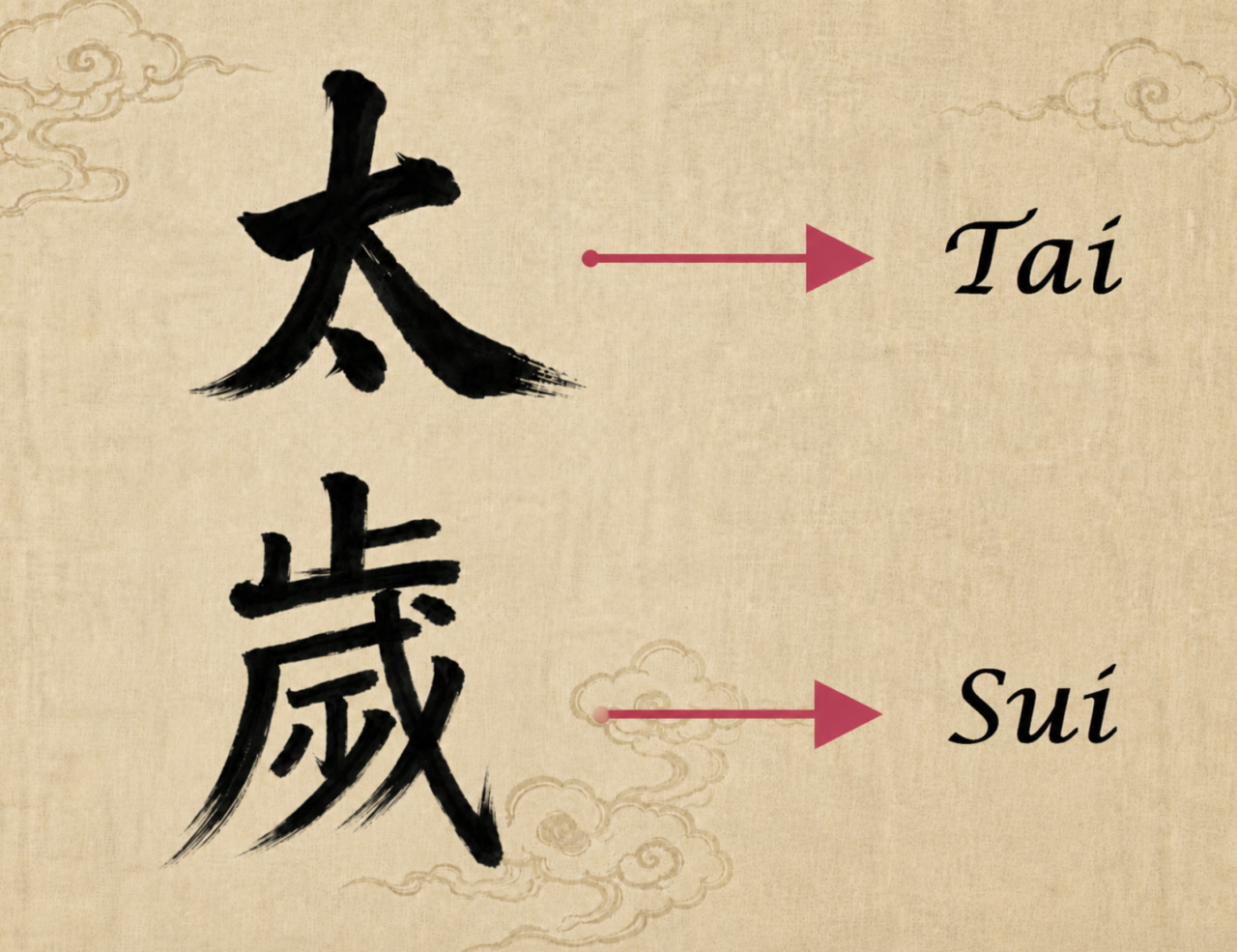
The two Chinese characters also help us understand the meaning. Tai means grand or great. Sui refers to year, age, or the yearly cycle. Together, Tai Sui points to something greater than an ordinary year. It refers to the annual authority that governs the year.
In simple words, the Tai Sui we talk about each year is a personified body of annual energy: the governing authority of that year.
Each year carries a different energetic pattern. In traditional Chinese metaphysics, this yearly energy is not treated as something random. It has direction, timing, elemental nature, zodiac relationship, and spiritual symbolism.
This is also why there are sixty Tai Sui Generals. The twelve Earthly Branches combine with the ten Heavenly Stems to form sixty combinations, known as the sixty-year Jia Zi cycle. Each year in this cycle is associated with a specific Tai Sui General, and each Tai Sui General reflects the deeper quality of that year.
This gives Tai Sui meaning on several levels: astronomical, metaphysical, cultural, and spiritual.
This is why Tai Sui is respected and taken seriously.
It is not merely a zodiac label. It is not simply a planet. It is not only a superstition about bad luck. Tai Sui is a way of understanding how the energy of a particular year interacts with people, places, and timing.
When your zodiac sign has a conflict with the Tai Sui of the year, we say you are Fan Tai Sui, or offending Tai Sui.
When a part of your home falls into the Tai Sui direction, that area should be treated with more caution.
When a month, day, or hour strongly clashes with the Tai Sui energy, it may not be ideal for beginning major activities.
This is the first important thing to understand:
Tai Sui is not one single warning that applies to everyone, every house, and every situation in the same way.
It has layers, aspects, and priorities.
Once these points of view are separated clearly, the fog of confusion can be dispelled, and the fear begins to soften. You can start to see which part applies to you, which part applies to your home, which part applies to timing, and which part may not be relevant to your situation at all.
This is also why a proper Tai Sui guide should not only say, “These zodiac signs offend Tai Sui this year.” That is only one layer.
A more complete understanding must look at Tai Sui through people, space, and time.
What Does Fan Tai Sui Mean?
Fan Tai Sui is usually translated as offending Tai Sui.
This phrase can sound frightening, especially for beginners. The word “offending” may make it seem as if you have done something wrong, angered a deity, or invited unavoidable misfortune. That is one reason many people become nervous when they first hear that their zodiac sign is Fan Tai Sui.
But Fan Tai Sui should not be understood only through fear.
In a more practical sense, Fan Tai Sui means your zodiac sign has a sensitive or conflicting relationship with the Tai Sui energy of the year. Because of that relationship, the year may feel less smooth, less stable, or more demanding in certain areas of life.
This does not mean disaster must happen.
It means the year may require more awareness.
For some people, Fan Tai Sui may show up as repeated obstacles, delays, emotional pressure, career instability, financial stress, health sensitivity, relationship tension, family concerns, or sudden changes. For others, the effect may be mild. Some people may even experience progress during a Fan Tai Sui year, but the progress may come through pressure, movement, responsibility, or uncomfortable change.
This is why it is not accurate to say:
“If you Fan Tai Sui, your year will be bad.”
A better way to understand it is:
“If you Fan Tai Sui, your relationship with the annual energy is more sensitive, so you should move through the year with more awareness, caution, and proper support.”
There are also different types of Fan Tai Sui. Some are stronger and more direct, such as clashing with Tai Sui. Some are more subtle, such as harming or breaking Tai Sui. Some relate to personal zodiac signs, while others relate to directions in the home or timing choices.
This is where many online explanations become too simple.
They give a list of zodiac signs and tell you to wear red, carry an amulet, or avoid bad luck, but they do not explain what kind of Tai Sui relationship you have, how serious it may be, or whether the advice truly applies to your situation.
That is why we need to break Fan Tai Sui down properly.
Before we talk about remedies, directions, talismans, or secret cures, we first need to understand the different ways a person can offend Tai Sui and why not all Fan Tai Sui years are the same.
Does Fan Tai Sui Mean Bad Luck? Not Always.
One of the biggest misconceptions about Fan Tai Sui is that it automatically means bad luck.
This is where many people begin to panic.
They hear that their zodiac sign offends Tai Sui this year, and they immediately assume something terrible must happen. Then they start reading online predictions about illness, accidents, financial loss, relationship problems, career obstacles, lawsuits, betrayal, and all kinds of frightening possibilities.
But this is not the right way to understand Fan Tai Sui.
Fan Tai Sui does not mean your year is doomed. It does not mean every decision will fail. It does not mean you should live the whole year in fear.
A more accurate way to understand Fan Tai Sui is this:
Your relationship with the annual energy is more sensitive.
That sensitivity may show up in different ways. For some people, it can bring more pressure, movement, conflict, emotional fluctuation, or unexpected change. For others, it may show up as delays, restlessness, health sensitivity, financial pressure, or difficulty getting support from the people around them.
But not every Fan Tai Sui year is the same.
Some people go through a Fan Tai Sui year and feel very little. Some experience a difficult year, but the difficulty comes through necessary change. Some may even experience progress, but the progress may come with pressure, responsibility, relocation, job change, relationship decisions, or other uncomfortable adjustments.
This is why we should not reduce Fan Tai Sui into a simple sentence like:
“If you offend Tai Sui, your luck will be bad.”
That kind of statement creates fear, but it does not create understanding.
A better question is:
“What kind of relationship do I have with the Tai Sui of the year, and how should I move through this year more carefully?”
This is also why a proper Tai Sui reading should consider more than just your zodiac sign. Your birth chart, your current life situation, your home Feng Shui, your timing, your health, your emotional condition, and your major decisions for the year can all influence how strongly you feel the Tai Sui effect.
For example, a person who is already facing career instability, family stress, health pressure, or financial uncertainty may feel Fan Tai Sui more strongly than someone whose life is already stable and supported.
This is not because Tai Sui is trying to punish one person more than another.
It is because Tai Sui tends to reveal friction where life is already sensitive.
That is why the purpose of Tai Sui guidance is not to scare you. The purpose is to help you see where caution is needed, where unnecessary action should be avoided, and where protection or adjustment may be helpful.
Fan Tai Sui is not a life sentence.
It is a reminder to move with awareness.
The Origin of Tai Sui: Why Tai Sui Is Not Simply Jupiter
Tai Sui is commonly translated as the Grand Duke of Jupiter.
This translation is useful, but it can also create one of the biggest misunderstandings about Tai Sui.
Tai Sui is not Jupiter.
At least, it is not the physical planet Jupiter itself.
The reason Tai Sui is connected with Jupiter comes from ancient timekeeping and celestial observation. In ancient China, especially during earlier historical periods when different states used different systems to measure and organize time, people needed a more unified way to understand the yearly cycle.
Jupiter became an important reference because its movement is close to a twelve-year cycle. From the perspective of ancient observation, Jupiter moves through the sky in a rhythm that roughly corresponds with the twelve divisions of the heavens and the twelve Earthly Branches.
This is why Jupiter became closely related to the twelve-year cycle.

But there was a problem.
Jupiter does not complete its orbit in exactly twelve years. Its actual orbital cycle is about 11.86 years. This small difference may not seem important at first, but over time, the difference accumulates. After enough years, the actual position of Jupiter would no longer match the ideal position expected in a clean twelve-year system.
In other words, physical Jupiter was not perfectly suitable as a long-term symbolic marker for the annual cycle.
To solve this, Tai Sui was created as an idealized reference.
It mirrors the ideal trail of Jupiter, not the imperfect physical movement of Jupiter itself.
This is why I say Tai Sui is not simply Jupiter. Tai Sui began with a Jupiter-related framework, but it gradually developed into something much deeper: a symbolic and metaphysical body of annual energy.
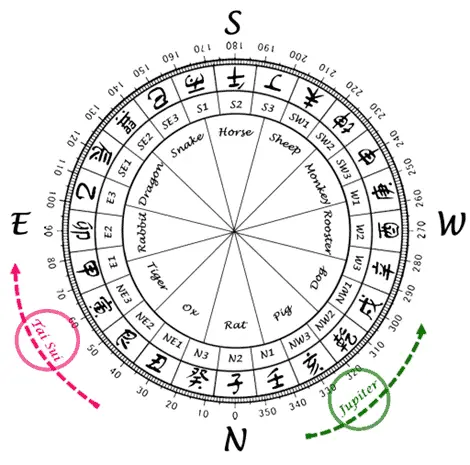
Tai Sui originated from a Jupiter-related framework, but it later developed far beyond Jupiter. It became an independent reference of annual energy in Chinese metaphysics, Feng Shui, date selection, and Daoist ritual practice.
That is why Tai Sui is not only astronomical, but also metaphysical. It is not only celestial, but also earthly. It is not only a time marker, but also carries direction, zodiac relationship, elemental nature, spiritual symbolism, and a personified form as a Tai Sui General.
A deeper way to understand Tai Sui is this:
Tai Sui is the personification of annual energy within a cosmic cycle of time.
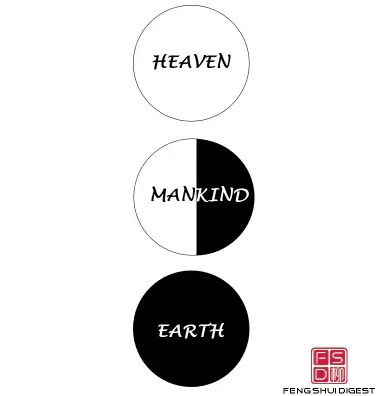
It began with the observation and idealization of Jupiter’s yearly rhythm, but it gradually became a symbolic and metaphysical authority used to understand the energetic pattern of each year. It reflects the relationship between Heaven, Earth, and Mankind.
Through Heaven, Tai Sui relates to time: the year, month, day, and hour.
Through Earth, Tai Sui relates to space: direction, location, house sector, building, property, and land.
Through Mankind, Tai Sui relates to people: zodiac signs, personal circumstances, decisions, health, relationships, and life events.
This is why Tai Sui can affect people, space, and time.
When we talk about Fan Tai Sui, we are talking about the relationship between a person’s zodiac sign and the annual Tai Sui energy.
When we talk about the Tai Sui direction, we are talking about where this annual authority resides in a home, building, office, property, or land.
When we talk about Tai Sui days, months, or hours, we are talking about timing that may conflict with the annual energy.
So if someone says Tai Sui is simply Jupiter, the explanation is too narrow.
If someone says Tai Sui is only a zodiac superstition, the explanation is also too shallow.
Tai Sui is better understood as a personified annual authority formed through celestial observation, traditional cosmology, metaphysical interpretation, and accumulated cultural experience.
This is why Tai Sui is respected and deserves serious attention in classical practice.
Not because we should live in fear.
But because this annual authority plays an important role across Heaven, Earth, and Mankind, exerting its influence through time, space, and people.
The Three Ways Tai Sui Affects You: People, Space, and Time
To understand Tai Sui clearly, we need to separate it into three major layers: people, space, and time.
This simple framework can remove a lot of confusion.
Many readers become overwhelmed because different articles are talking about different things under the same name. One article may say your zodiac sign offends Tai Sui. Another may warn you not to renovate a certain direction. Another may say to avoid certain days or months. Another may suggest prayer, red clothing, Pi Yao, or a Tai Sui amulet.
Without structure, all of this gets mixed together.
But once we separate Tai Sui into people, space, and time, the picture becomes much clearer.
People
The people layer is what most beginners hear about first.
This is when your zodiac sign has a certain relationship with the Tai Sui of the year. If your zodiac sign clashes, harms, breaks, or forms another sensitive relationship with the annual Tai Sui, we say you are Fan Tai Sui.
This does not mean every person under that zodiac sign will experience the same year. It simply means that group of people has a more sensitive relationship with the annual energy and should move through the year with more awareness.
This is the layer most annual zodiac articles talk about.
Space
The space layer belongs more directly to Feng Shui.
Every year, Tai Sui occupies a certain direction. The opposite direction is called Sui Po, or the Year Breaker. These directions should generally be kept calm and stable.
This is why Feng Shui practitioners caution against renovation, demolition, drilling, digging, hammering, or heavy disturbance in the Tai Sui and Sui Po sectors.
This does not mean you cannot use the room, or you must abandon that part of the house. It means the area should not be aggressively disturbed.
The space layer answers questions such as:
“Can I renovate this area?”
“Can I drill into this wall?”
“Is my main entrance affected?”
“What if my bedroom is in the Tai Sui sector?”
“What if construction already happened there?”
Time
The time layer is often overlooked, but it is important.
Certain months, days, and hours may carry stronger conflict with Tai Sui. In date selection, these time periods are usually treated with caution, especially for major activities such as starting renovation, opening a business, signing important agreements, moving into a home, beginning construction, or launching something significant.
This does not mean every ordinary activity must be controlled by Tai Sui timing.
You do not need to panic over every meal, phone call, or normal daily task.
But for major beginnings and important actions, timing matters.
Once you understand these three layers, Tai Sui becomes much less mysterious.
You can ask:
Is this about my zodiac sign?
Is this about my home direction?
Is this about the timing of an important action?
That alone can save you from a lot of unnecessary fear.
Tai Sui and People: The Five Types of Fan Tai Sui
Now that we have separated Tai Sui into people, space, and time, we can begin with the layer most readers care about first: people.
When someone says, “You Fan Tai Sui this year,” they are usually talking about your zodiac sign.
But even here, not all Fan Tai Sui is the same.
There are different types of relationships between a person’s zodiac sign and the Tai Sui of the year. Some are more direct. Some are more confrontational. Some are more hidden. Some create pressure through conflict, while others create instability through harm, punishment, or breakage.
This is why two people can both be said to “offend Tai Sui,” but their experience may feel very different.
One person may face obvious change, confrontation, or movement.
Another may feel emotional pressure, repeated obstacles, or conflict with people around them.
Another may experience hidden tension, broken cooperation, financial leakage, or plans that do not move as smoothly as expected.
For readers familiar with Western astrology, you may loosely think of some of these relationships like energetic aspects. Against Tai Sui is somewhat like conjunction, because the zodiac sign stands directly with the annual energy. Clash with Tai Sui is similar to opposition, because the zodiac sign directly confronts the annual energy. Afflicted by Tai Sui is somewhat like a tense square, because it creates pressure, friction, and strain.
The comparison is not exact, because Tai Sui belongs to Chinese metaphysical practice, not Western astrology. But the analogy can help beginners understand why different Tai Sui relationships may create different kinds of pressure.
This is why it is important to understand the different types of Fan Tai Sui instead of treating them all as the same.
| Types of Fan Tai Sui | Basic Meaning | Possible Manifestation |
|---|---|---|
| Against Tai Sui | Your zodiac sign is the same as the Tai Sui of the year; loosely similar to conjunction in astrology | Personal pressure, emotional fluctuation, health sensitivity, career obstruction, interpersonal disputes |
| Clash with Tai Sui | Your zodiac sign directly clashes with the Tai Sui of the year; loosely similar to opposition in astrology | Change, movement, conflict, instability, disruption, unexpected events |
| Afflicted by Tai Sui | Your zodiac sign forms a punishment or affliction relationship with the Tai Sui; loosely similar to a tense square in astrology | Pressure from rules, contracts, paperwork, mistakes, arguments, legal concerns, interpersonal friction, repeated obstacles |
| Harmed by Tai Sui | Your zodiac sign forms a harm relationship with the Tai Sui | Hidden tension, misunderstanding, betrayal, cooperation breakdown, loss of support, financial or emotional damage |
| Broken by Tai Sui | Your zodiac sign forms a break relationship with the Tai Sui | Broken plans, delay, instability, weakened support, small losses, leakage of money or opportunity |
Five Types of Fan Tai Sui
This table gives a simple overview, but it should not be used to judge your whole year by itself.
Your zodiac sign is only one layer.
A person’s full birth chart, life circumstances, Feng Shui environment, health condition, decisions, and timing can all change how strongly they experience Fan Tai Sui.
Still, this table is helpful because it shows why the phrase “offending Tai Sui” is too broad by itself.
The next step is to understand each type more clearly.
Against Tai Sui
Against Tai Sui happens when your zodiac sign is the same as the Tai Sui of the year.
For example, in a Goat year, people born under the Goat sign are considered against Tai Sui.
This relationship is sometimes misunderstood. Many people assume the zodiac sign of the year must be lucky because it is “their year.” But in Tai Sui practice, being the same as the annual branch means you are standing directly in the annual Tai Sui position.
In Western astrology, this can be loosely compared to a conjunction. The energy is not necessarily hostile, but it is direct, close, and difficult to ignore.
This can bring more pressure, visibility, responsibility, emotional sensitivity, or personal instability.
The year may feel as if it is touching you directly.
It may also bring situations where your own mindset, decisions, health condition, or emotional state becomes more important than usual. Sometimes the challenge is not only outside of you; it may also come from inner restlessness, pressure, hesitation, or overreaction.
This does not mean everything will be bad.
But it does mean you should be more careful with major decisions, health, conflict, and unnecessary risk.
Clash with Tai Sui
Clash with Tai Sui is usually considered one of the stronger forms of Fan Tai Sui.
It happens when your zodiac sign directly opposes the Tai Sui of the year.
In the twelve zodiac system, there are six direct clash pairs: Rat and Horse, Ox and Goat, Tiger and Monkey, Rabbit and Rooster, Dragon and Dog, and Snake and Pig. When the year’s Tai Sui belongs to one zodiac, the zodiac directly opposite it is considered to clash with Tai Sui.

For example, in a Goat year, the Ox zodiac clashes with Tai Sui because Ox and Goat form one of the six direct clash pairs.
In Western astrology, this is loosely similar to opposition. The two sides face each other directly, creating confrontation, movement, and tension.
A clash often brings change, movement, conflict, or disruption. This can show up as moving, changing jobs, relationship shifts, conflict with others, travel issues, sudden decisions, or unexpected events.
But clash does not always mean disaster.
Sometimes, a clash forces movement where life has become stuck. The problem is that this movement may feel unstable, pressured, or difficult to control.
During a clash year, the main concern is not only that things may change. The deeper concern is that change may come too quickly, too forcefully, or at the wrong time.
So the key during a Tai Sui clash year is not to freeze in fear, but to avoid reckless decisions and prepare for change more carefully.
Afflicted by Tai Sui
Afflicted by Tai Sui usually refers to punishment or penalty relationships with the Tai Sui of the year.
This type of Fan Tai Sui can feel less direct than a clash, but it may still be uncomfortable.
In Western astrology, this can be loosely compared to a tense square. It may not always create open confrontation, but it creates pressure, friction, and internal strain.
Afflicted by Tai Sui can show up as repeated obstacles, emotional stress, pressure from rules, workplace conflict, family tension, legal concerns, contract problems, health sensitivity, or a feeling that small problems keep accumulating.
The difficulty with this type is that it may not always come as one big event.
It may feel like many small things are wearing you down over time.
You may also feel that you are being restricted, judged, blamed, misunderstood, or forced to deal with rules, procedures, paperwork, contracts, agreements, or consequences caused by past mistakes.
This is why people afflicted by Tai Sui should pay attention to emotional regulation, communication, contracts, legal matters, health routines, and unnecessary arguments.
The Four Reference Groups for Those Afflicted by Tai Sui
To identify which zodiac signs are afflicted by Tai Sui, we can refer to four main zodiac relationship groups.Affliction Group Zodiac Signs Group 1 Rat and Rabbit Group 2 Ox, Goat, and Dog Group 3 Tiger, Snake, and Monkey Self-afflicted group Dragon, Horse, Rooster, and Pig
Group 1: Rat and Rabbit
Group 2: Ox, Goat, and Dog
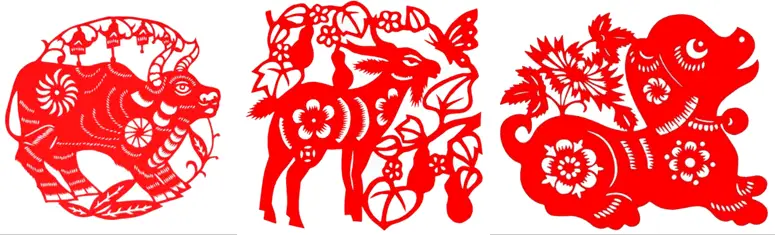
Group 3: Tiger, Snake, and Monkey
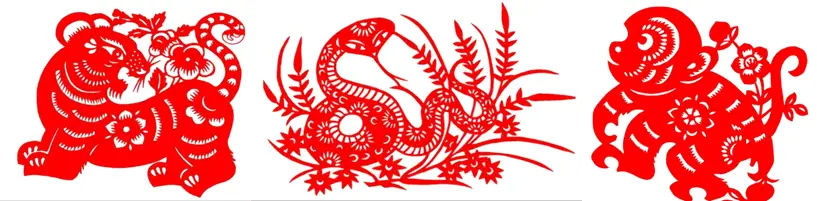
Self-afflicted group: Dragon, Horse, Rooster, and Pig
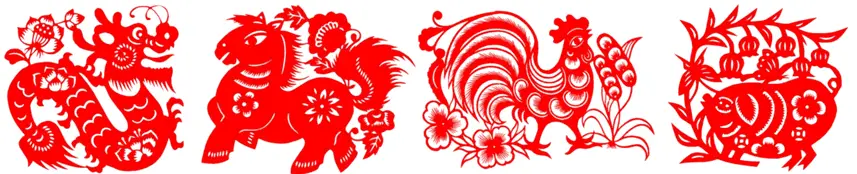
For the first three groups, you can look at the zodiac of the year first. The other zodiac signs in the same group may be considered afflicted by Tai Sui.
For example, in a Tiger year, we look at the Tiger, Snake, and Monkey group. Since Tiger is the zodiac of the year, Snake and Monkey may be considered afflicted by Tai Sui.
In a Goat year, we look at the Ox, Goat, and Dog group. Since Goat is the zodiac of the year, Ox and Dog may be considered afflicted by Tai Sui.
The fourth group is slightly different.
Dragon, Horse, Rooster, and Pig are self-afflicted. This means that in a Dragon year, the Dragon zodiac is not only against Tai Sui, but may also be self-afflicted by Tai Sui. The same logic applies to Horse year, Rooster year, and Pig year.
This is one reason some zodiac signs may experience a Tai Sui year more strongly than others. They may not only be against the annual Tai Sui, but also carry an additional affliction relationship.
For beginners, you do not need to memorize all of these groups immediately.
The important point is this:
Afflicted by Tai Sui is not random. It follows specific zodiac relationship groups, and those groups help explain why certain signs may experience extra pressure, punishment-like situations, mistakes, emotional strain, legal concerns, or repeated obstacles during a Tai Sui year.
Harmed by Tai Sui
Harmed by Tai Sui often relates to hidden tension.
This type may involve relationship discomfort, betrayal, misunderstanding, hidden enemies, emotional hurt, damaged cooperation, loss of support, or situations where something does not feel openly confrontational but still creates pressure.
Unlike a clash, which is usually obvious, harm can be quieter.
You may not immediately see where the problem is coming from. It may appear through people, trust issues, family matters, workplace politics, business partnerships, financial decisions, or emotional unease.
This is why a harm year can feel confusing.
On the surface, things may look stable. Underneath, there may be hidden waves, private disappointment, unclear intentions, or slow damage to trust and cooperation.
For this reason, a harm year often requires better boundaries, careful communication, and less blind trust.
The Six Harming Pairs
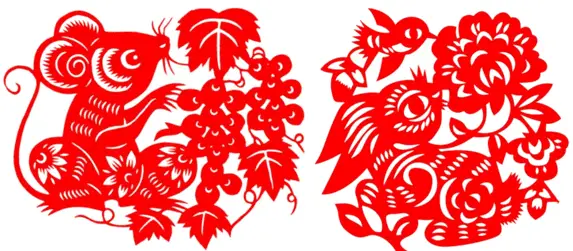
To identify which zodiac sign is harmed by Tai Sui, we can refer to the six harming pairs, Rat and Goat, Ox and Horse, Tiger and Snake, Rabbit and Dragon, Rooster and Dog, Pig and Monkey. Their relationship can be visualized as below:
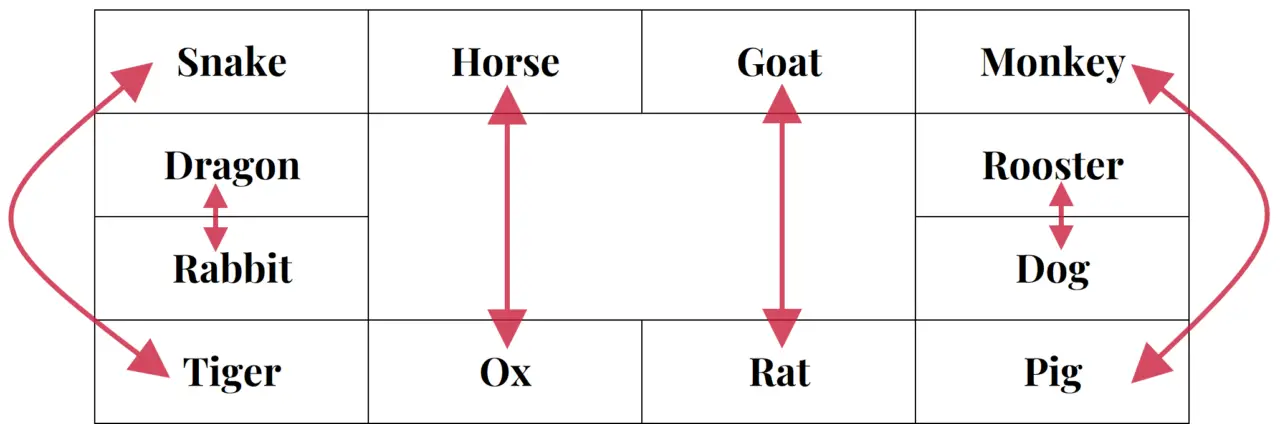
When one zodiac becomes the annual Tai Sui zodiac, the paired zodiac is considered harmed by Tai Sui.
For example, in a Tiger year, Snake is harmed by Tai Sui.
In a Rabbit year, Dragon is harmed by Tai Sui.
In a Goat year, Rat is harmed by Tai Sui.
Harmed by Tai Sui often affects the hidden support field around a person. It may not always appear as open conflict. Instead, it may show up through misunderstanding, backstabbers, damaged cooperation, relationship entanglement, job changes, illness, emotional pressure, or situations where help does not arrive when needed.
For beginners, the important point is this:
Harmed by Tai Sui often works quietly. It may weaken support, create hidden tension, and disturb relationships or cooperation before the problem becomes obvious.
Broken by Tai Sui
Broken by Tai Sui is often associated with instability, separation, weakened support, or broken plans.
It may not feel as forceful as a direct clash, but it can still disturb the smoothness of the year. Plans may change. Agreements may become unstable. Relationships may weaken. Support may not arrive as expected.
The word “break” does not mean everything must collapse.
It means certain connections, plans, finances, relationships, or structures may not hold as firmly as before.
This can show up as delay, small losses, financial leakage, weakened cooperation, interrupted plans, unstable agreements, or a sense that things keep slipping away before they fully settle.
During this kind of year, it is wise to avoid relying only on verbal promises, unclear agreements, or unstable arrangements. It is better to confirm details, prepare backup plans, and avoid assuming everything will continue exactly as before.
The Six Breaking Pairs
To identify which zodiac sign is broken by Tai Sui, we can refer to the six breaking pairs: Rat and Rooster, Ox and Dragon, Tiger and Pig, Rabbit and Horse, Dog and Goat, Monkey and Snake.
When one zodiac becomes the annual Tai Sui zodiac, the paired zodiac is considered broken by Tai Sui.
For example:
In a Dragon year, Ox is broken by Tai Sui.
In a Rabbit year, Horse is broken by Tai Sui.
In a Goat year, Dog is broken by Tai Sui.
At first, the Six Breaking Pairs may look random. But if you observe the zodiac circle closely, you will find that each breaking pair is separated by a 90-degree relationship.
A simple way to understand the rule is through the Yin and Yang nature of the zodiac signs.
The Yang zodiac signs are: Rat, Tiger, Dragon, Horse, Monkey, and Dog.
The Yin zodiac signs are: Ox, Rabbit, Snake, Goat, Rooster, and Pig.
If the base zodiac is Yin, start with the base zodiac as number one and count forward clockwise. The fourth zodiac is the breaking zodiac.
For example, Ox is a Yin zodiac. Start with Ox as one, Tiger as two, Rabbit as three, and Dragon as four. Therefore, Dragon is the breaking zodiac for Ox.

If the base zodiac is Yang, start with the base zodiac as number one and count backward counterclockwise. The fourth zodiac is the breaking zodiac.
For example, Rat is a Yang zodiac. Start with Rat as one, Pig as two, Dog as three, and Rooster as four. Therefore, Rooster is the breaking zodiac for Rat.

Broken by Tai Sui is usually considered milder than a direct clash or punishment, but it should not be ignored. Its influence may happen under the surface, behind the scenes, or in ways that are not immediately obvious.
It may show up as broken plans, weakened trust, hidden financial leakage, unstable cooperation, delayed progress, interrupted agreements, betrayal, or situations where something quietly falls apart before you fully realize it.
This is why a Broken Tai Sui year calls for careful confirmation, stronger boundaries, written agreements, backup plans, and less blind reliance on unstable promises.
For beginners, the important point is this:
Broken by Tai Sui often affects stability. It may not strike loudly, but it can quietly weaken plans, relationships, money, trust, or support.
These five types help us understand why Fan Tai Sui cannot be reduced to one general warning.
Some relationships are direct. Some are hidden. Some bring movement. Some bring emotional pressure. Some affect stability, trust, money, health, or cooperation.
The reference groups and pairs above are not meant to frighten you or force you to memorize every zodiac relationship.
They are here to show that Fan Tai Sui is not random.
Each type of conflict follows a specific relationship pattern. Once you understand the pattern, you can better understand why one person may experience direct conflict, another may experience hidden betrayal, another may face repeated obstacles, and another may simply feel that plans are not holding together.
This is why the phrase “offending Tai Sui” is too broad by itself.
The type of conflict matters.
When you know which type applies, you can respond with more precision instead of panic.
In the next section, we will look at the common signs of a difficult Tai Sui year, so you can better understand what people may actually experience when the annual energy becomes sensitive.
Common Signs of a Difficult Tai Sui Year
After understanding the five types of Fan Tai Sui, the next natural question is:
What does a difficult Tai Sui year actually feel like?
This is where we need to be careful.
A difficult Tai Sui year does not look the same for everyone. It does not mean every person will experience disaster, illness, financial loss, or relationship breakdown. It also does not mean nothing good can happen.
A better way to understand it is this:
Tai Sui often acts like an amplifier.
It does not always create something completely from nothing. More often, it activates, magnifies, or exposes what is already sensitive in your natal chart, Feng Shui, life stage, decisions, health condition, relationship pattern, career situation, or emotional state.
If there is already instability, Tai Sui may make the instability harder to ignore.
If there is already conflict, Tai Sui may bring the conflict to the surface.
If there is already pressure, Tai Sui may increase the weight of that pressure.
If there is already a major transition waiting to happen, Tai Sui may become the year when movement finally takes place.
This is why some people experience Fan Tai Sui as repeated problems, while others experience it as change, movement, responsibility, or a turning point.
Sometimes it is an issue.
Sometimes it is several problems appearing together.
Sometimes it is a positive trait or hidden potential becoming activated, but through pressure, responsibility, visibility, or uncomfortable growth.
This is also why Tai Sui should not be read only as “bad luck.”
It is more accurate to say that Tai Sui can make certain parts of life more sensitive, more exposed, and more difficult to ignore.
Common signs of a difficult Tai Sui year may include:
1. Repeated obstacles and delays
Things may not move as smoothly as expected.
Plans may be delayed. Paperwork may take longer. Decisions may become harder. People may change their minds. Help may arrive late. A project that should have been simple may suddenly require more effort than usual.
This does not always mean the path is blocked forever.
It may mean the timing is unstable, the support is not ready, or the situation needs more preparation before it can move forward.
2. Emotional pressure and inner restlessness
Some people feel more emotionally sensitive during a difficult Tai Sui year.
They may become more anxious, irritable, impatient, doubtful, or easily affected by other people’s words and actions. Small problems may feel heavier than usual. Unresolved emotions may rise to the surface.
This is especially common when Tai Sui touches an already sensitive part of the person’s chart or life situation.
The year may feel like it is asking you to face something you can no longer avoid.
3. Physical movement and life transition
Tai Sui does not only show up as mental pressure.
It can also bring movement.
This may include travel, relocation, moving house, changing rooms, changing offices, changing jobs, changing departments, changing business direction, or shifting from one stage of life into another.
For some people, this movement is external and obvious.
For example, they may move to a new home, start a new job, leave an old workplace, travel more than usual, or deal with changes in family structure.
For others, the movement may be more personal: going from single to married, married to divorced, becoming pregnant, welcoming a baby, taking care of aging parents, entering a new career stage, or stepping into a new responsibility.
These changes are not always bad.
But during a Tai Sui year, transition may feel less stable, more pressured, or harder to control. This is why major decisions should be made with more awareness, not emotional reaction.

4. Career pressure and unstable support
A difficult Tai Sui year may affect work, career, reputation, or support from others.
Some people may feel overlooked, challenged, criticized, blocked, or forced to prove themselves. Others may experience workplace politics, management changes, heavier responsibility, job instability, or uncertainty about their next direction.
Sometimes the issue is not that opportunity is absent.
The issue is that opportunity comes with pressure.
A new role may require more responsibility. A promotion may bring more conflict. A career change may bring both possibility and instability. A business opportunity may require careful judgment before commitment.
This is why Tai Sui years often require patience, humility, and clearer decision-making.

5. Relationship tension and people problems
Tai Sui can also show up through people.
Misunderstandings may increase. Cooperation may break down. Support may become weaker. Trust may become more fragile. Arguments may arise more easily. Hidden resentment may surface.
For some, this may affect romantic relationships or marriage.
For others, it may involve family members, friends, business partners, clients, coworkers, supervisors, or people who quietly create obstruction behind the scenes.
This is especially relevant for harmed Tai Sui, afflicted Tai Sui, or broken Tai Sui years, where the difficulty may not always be direct and obvious.
Sometimes the most exhausting part is not one major conflict, but many small disappointments that slowly weaken trust.
6. Financial pressure or leakage
A difficult Tai Sui year may also appear through money.
This does not always mean major financial loss. It may show up as extra expenses, unstable income, delayed payment, repair costs, medical expenses, family spending, poor investment timing, business uncertainty, or money that comes in but does not stay.
This is why people often describe certain Tai Sui years as a year of leakage.
The money may not disappear all at once, but it may be harder to preserve, organize, or use wisely.
During such a year, it is better to avoid impulsive investments, unclear agreements, emotional spending, or trusting promises without proper confirmation.

7. Health sensitivity and lowered vitality
Health can become more sensitive during a difficult Tai Sui year, especially if the person is already tired, stressed, recovering, emotionally burdened, or ignoring long-term physical signals.
This does not mean Tai Sui guarantees illness.
It means the body may become less tolerant of pressure.
Fatigue, sleep issues, old discomfort, emotional exhaustion, or lowered vitality may become more noticeable. If health concerns appear, they should be taken seriously and handled properly instead of being ignored.
In Feng Shui and metaphysical practice, health is never viewed separately from lifestyle, environment, emotional state, timing, and personal choices.
A Tai Sui year is a reminder to reduce unnecessary risk and take better care of the body.
8. Accidents, conflict, or careless mistakes
Some Tai Sui years can make people more prone to rushed decisions, emotional reactions, arguments, travel disruptions, physical bumps, minor accidents, or mistakes caused by carelessness.
This is especially true when the year already brings movement, pressure, or conflict.
The point is not to live in fear.
The point is to slow down where needed.
Drive more carefully. Read contracts more carefully. Avoid unnecessary confrontation. Do not act only from anger, panic, or pride. Do not force major action when the situation is unstable.
Many Tai Sui problems become worse not because of Tai Sui alone, but because a person reacts carelessly under pressure.
9. The feeling that life is forcing a decision
Sometimes the most obvious sign of a Tai Sui year is not one event.
It is the feeling that life is pushing you to make a decision.
Should I stay or leave?
Should I continue or stop?
Should I move, change, repair, commit, separate, accept, reject, or begin again?
This can feel uncomfortable because Tai Sui often brings attention to areas that can no longer remain vague.
The year may force clarity.
That clarity may come through pressure, but it can still lead to a better direction if handled with awareness.
These signs do not mean every Fan Tai Sui year must be painful.
They simply show the kinds of areas that may become more active, sensitive, or unstable when your relationship with the annual Tai Sui energy is strong.

A Deeper Way to Understand Tai Sui Influence
But this is still only the common surface.
In real life, most people’s natal charts are complex. A Tai Sui year may not activate only one simple issue. It may touch several sensitive areas at once, and those areas can include both positive and negative possibilities.
This is why an old saying describes Tai Sui this way:
“When Tai Sui weighs upon a person, the year often brings either great joy or great trouble.”
Many people interpret this saying only as a warning of bad luck, but its meaning is more subtle.
A Tai Sui year is often a year of movement. If the energy is not expressed through joyful events, it may express itself through pressure, fluctuation, conflict, or trouble.
For some people, this movement may appear as marriage, pregnancy, childbirth, relocation, career change, promotion, business transition, or an important life decision.
For others, it may appear as conflict, instability, financial pressure, health sensitivity, relationship tension, or repeated obstacles.
Sometimes both can happen in the same year.
It may bring joy, but not always with ease.
It may bring change, but not always with stability.
It may bring opportunity, but often with pressure, responsibility, or risk.
So the question is not simply:
“Will this year be good or bad?”
A better question is:
What is being activated, and how should I respond to it wisely?
The key is not to panic.
The key is to observe carefully.
Where is life already sensitive?
Where are you being pressured to move, change, repair, decide, or mature?
Where should you slow down instead of forcing action?
Where should you seek help instead of carrying everything alone?
Once you understand this, Tai Sui becomes less like a vague threat and more like a signal.
It shows you where caution, adjustment, and awareness are needed.
In the next section, we will move from people to space, and look at why the Tai Sui direction and Sui Po direction matter in Feng Shui.
Tai Sui and Space: Direction, Sui Po, and the 24 Mountains
When we move from people to space, Tai Sui takes on another important meaning.
It is no longer only about which zodiac sign is in conflict with the energy of the year. It is also about where that annual authority resides in physical space.
Every year, Tai Sui occupies a specific direction.
The direction directly opposite Tai Sui is called Sui Po, or the Year Breaker.
In Feng Shui practice, both directions deserve attention. The Tai Sui direction represents the seat of the year’s authority, while the Sui Po direction reflects the point that directly opposes it. This is why both areas are usually treated with more caution, especially when it comes to renovation, drilling, demolition, digging, or strong disturbance.
This is also where a great deal of confusion begins.
Many Feng Shui practitioners are familiar with the 24 Mountains system, so they naturally assume that Tai Sui must sit only in the specific zodiac mountain of the year. But in actual Tai Sui practice, the annual Tai Sui direction follows the 12 zodiac houses, not just the narrower zodiac mountain in the 24 Mountains system.
This distinction matters.
The charting of the 12 zodiac houses came earlier. In that system, the full 360 degrees of a circle are divided into twelve equal sectors, each one covering 30 degrees. Each zodiac house therefore governs a complete 30-degree range.
Later, the 24 Mountains system added another layer of precision. It integrates the 12 Earthly Branches, 8 of the 10 Heavenly Stems, and 4 of the 8 trigrams, creating 24 sectors of 15 degrees each.
As shown in the picture below, the blue highlighted sections are the 12 zodiac mountains, also known as the 12 Earthly Branches. The remaining sections are made up of the 8 Heavenly Stems and 4 trigrams.
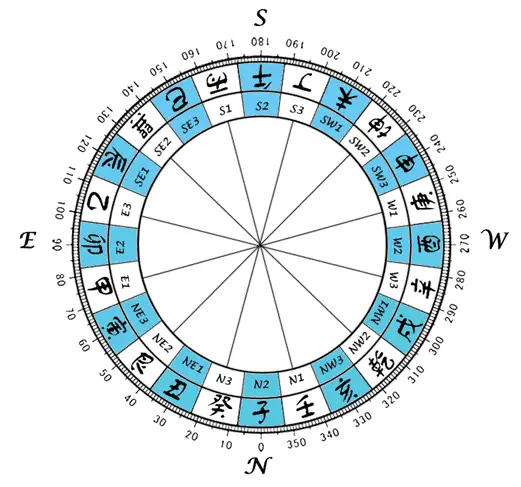
This is extremely useful in Feng Shui. It does not only provide more detailed directional information; it also resonates with the 24 solar terms and helps connect the three important dimensions of traditional practice: Heaven, Earth, and Mankind.
In this sense, the 24 Mountains system is not merely a compass division. It is a refined framework that brings together celestial timing, earthly direction, and human application.
But more detail does not always mean it replaces the older annual framework.
For Tai Sui, what we need to pay attention to is the zodiac house, not just the single zodiac mountain.
That is why, in my Tai Sui articles, I consistently use the broader 30-degree zodiac house range for Tai Sui and Sui Po, rather than the narrower and more popular zodiac-mountain version.
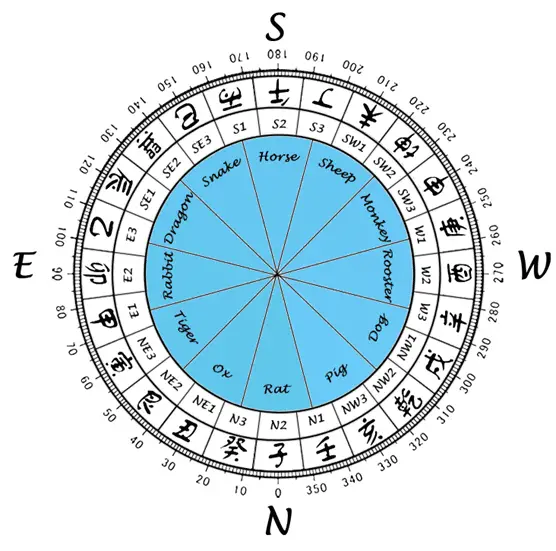
For example, in a Goat year, Tai Sui is in the Goat direction.
But the Goat direction does not refer only to the 15-degree Goat mountain in the 24 Mountains system.
It refers to the full 30-degree House of the Goat, which includes the Goat mountain plus an additional 7.5 degrees on each side of its adjacent mountains, making the complete Tai Sui range 195° to 225°.
The same logic applies to Sui Po.
Since Sui Po is directly opposite Tai Sui, in a Goat year the Sui Po direction falls in the House of the Ox, covering the full 30-degree range from 15° to 45°, not just the narrower 15-degree Ox mountain.
Why Some Websites Give Different Tai Sui Directions
This is one reason you may see different Tai Sui directions on different websites.
One website may say Tai Sui is in the Goat direction. Another may say it is in the Southwest. Another may give only the narrow Goat mountain. Another may give a broader degree range.
This does not always mean everyone is completely wrong.
Often, they are using different levels of the compass system.
The narrower version usually comes from the 24 Mountains system. In the 24 Mountains, each mountain covers 15 degrees. So when people say Tai Sui is in the Goat mountain, they may only be referring to the 15-degree Goat mountain itself.
The broader version comes from the 12 zodiac houses. In this method, each zodiac house covers 30 degrees. This includes the zodiac mountain itself, plus 7.5 degrees on each side from the neighboring mountains.
For annual Tai Sui and Sui Po practice, I use the broader 30-degree zodiac house method.
This does not mean the 24 Mountains are unimportant.
They are very important.
But the annual Tai Sui direction belongs first to the zodiac-house framework. The 24 Mountains offer more detailed directional refinement, but they should not reduce Tai Sui to only one narrow 15-degree mountain when the annual house itself carries the Tai Sui presence.
For practical Feng Shui, the broader method is also safer.
If you are deciding whether to renovate, drill, demolish, dig, or heavily disturb an area, it is better to respect the full Tai Sui house than to assume only the exact zodiac mountain matters.
This is especially important for beginners.
If you are not trained in compass reading, 24 Mountains, or advanced Feng Shui measurement, using the broader Tai Sui and Sui Po direction gives you a clearer and safer guideline.
So when you see different Tai Sui directions online, ask this question:
Are they talking about the narrow zodiac mountain, or the full zodiac house?
That one question can clear up a lot of confusion.
How to Use This Direction in Practice
If a room, entrance, office, work area, or important part of a property falls in the Tai Sui or Sui Po sector, it does not mean you must panic or stop using the space altogether.
It means you should understand that the area carries more annual sensitivity and should not be carelessly disturbed.
You can still walk through the area.
You can still sleep in the room if it is your bedroom.
You can still sit there, clean lightly, open the window, or use the space normally.
The main concern is strong disturbance.
This includes renovation, drilling, demolition, wall-breaking, digging, heavy hammering, repeated vibration, or beginning major construction from that sector.
This is why the Tai Sui direction and Sui Po direction are so important in annual Feng Shui.
They tell us where the yearly energy is seated, where its opposite lies, and which areas of a home or property deserve more respect and caution.
In the next section, I will give you a clearer reference table for the Tai Sui and Sui Po directions.
Tai Sui and Sui Po Direction Table
Now that we understand why Tai Sui and Sui Po should be read through the broader zodiac-house method, the next step is to look at the actual directional ranges.
Each zodiac house covers 30 degrees.
Tai Sui occupies the zodiac house of the year. Sui Po, or the Year Breaker, occupies the direction directly opposite Tai Sui.
The table below gives the general Tai Sui and Sui Po directions for each zodiac year.Zodiac Year Tai Sui Direction Tai Sui Degree Range Sui Po Direction Sui Po Degree Range Rat Year House of the Rat 345°–15° House of the Horse 165°–195° Ox Year House of the Ox 15°–45° House of the Goat 195°–225° Tiger Year House of the Tiger 45°–75° House of the Monkey 225°–255° Rabbit Year House of the Rabbit 75°–105° House of the Rooster 255°–285° Dragon Year House of the Dragon 105°–135° House of the Dog 285°–315° Snake Year House of the Snake 135°–165° House of the Pig 315°–345° Horse Year House of the Horse 165°–195° House of the Rat 345°–15° Goat Year House of the Goat 195°–225° House of the Ox 15°–45° Monkey Year House of the Monkey 225°–255° House of the Tiger 45°–75° Rooster Year House of the Rooster 255°–285° House of the Rabbit 75°–105° Dog Year House of the Dog 285°–315° House of the Dragon 105°–135° Pig Year House of the Pig 315°–345° House of the Snake 135°–165°
For practical Feng Shui use, these directions should be measured from the center of the home, building, room, office, or property, depending on what you are analyzing.
If the Tai Sui or Sui Po sector falls in a quiet storage area, unused corner, or lightly used room, the concern may be milder.
If it falls in a main entrance, bedroom, kitchen, office, renovation zone, drilling area, construction area, or frequently disturbed part of the property, then more caution is needed.
The main rule is simple:
Do not carelessly disturb Tai Sui or Sui Po.
This does not mean you cannot walk through the area, sleep in the room, or use the space normally. It means you should avoid strong disturbance such as renovation, demolition, wall-breaking, drilling, digging, heavy hammering, loud construction, or repeated vibration in these sectors whenever possible.
This table gives the general yearly reference.
For current-year details, always check the annual Tai Sui guide, because each year may also interact with other annual Feng Shui influences such as Five Yellow, Three Killings, Flying Stars, or specific elemental cures.
Tai Sui and Time: Tai Sui Days, Months, and Hours
Tai Sui does not only affect people and space.
It also affects time.
This is the third layer that many beginners overlook.
When people talk about Fan Tai Sui, they usually think of zodiac signs. When Feng Shui practitioners talk about Tai Sui direction, they think of space. But in date selection and traditional metaphysical practice, Tai Sui can also appear through months, days, and hours.
This is why certain time periods may be treated with more caution.
In traditional date selection, choosing a time for an important event is not simply about finding a convenient date on the calendar.
A deeper way to understand it is this:
When you choose the starting time of an important event, you are giving that event its own “birth chart.”
A wedding has a beginning.
A business opening has a beginning.
A renovation has a beginning.
A contract signing has a beginning.
A move-in date has a beginning.
A lawsuit, negotiation, construction project, product launch, ceremony, or major financial commitment also has a beginning.
That beginning carries energy.
Just as a person’s birth time gives the person a natal chart, the starting time of an event gives that event its own energetic pattern. A well-selected time helps reduce friction, attract support, strengthen momentum, and give the event a smoother beginning from the Heaven aspect.
This is why timing matters.
It is not because we need to fear every day or every hour. It is because important events deserve a better beginning.
Tai Sui is one of the immediate and powerful annual factors considered in this process. If the selected month, day, or hour strongly conflicts with the annual Tai Sui energy, the event may begin with more friction, resistance, instability, or hidden difficulty.
For example, in a Goat year, Goat-related timing may carry the Tai Sui energy of the year more strongly. The opposite Ox-related timing may carry Sui Po conflict more strongly.
This can apply to:
- Tai Sui month
- Sui Po month
- Tai Sui day
- Sui Po day
- Tai Sui hour
- Sui Po hour
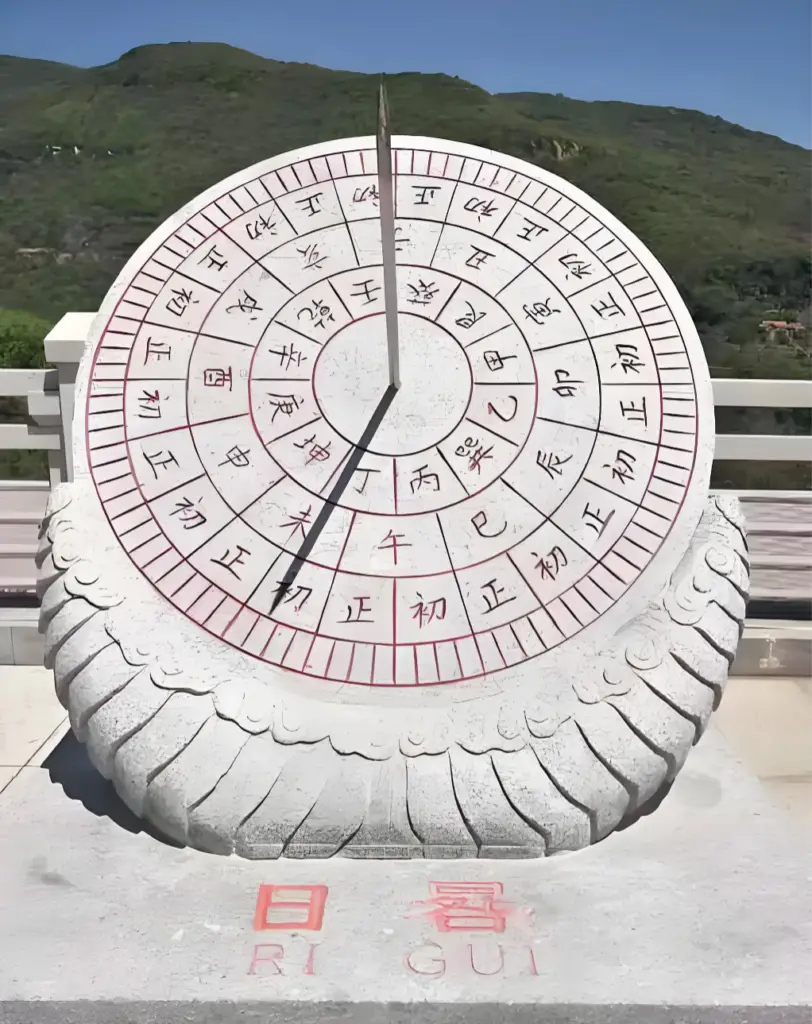
Tai Sui Month and Sui Po Month
A Tai Sui month is the zodiac month that carries the same Earthly Branch as the Tai Sui of the year.
A Sui Po month is the zodiac month that carries the opposite Earthly Branch.
For example, in a Goat year, the Goat month is the Tai Sui month, while the Ox month is the Sui Po month.
Chinese zodiac months generally follow the solar terms, not the ordinary Western calendar month. Because of this, the general range stays mostly the same each year, but the exact start and end date may shift slightly from year to year.
For example, the Goat month is generally around early July to early August, while the Ox month is generally around early January to early February. However, the exact dates should be checked according to the specific year.
This is why annual Tai Sui articles are useful.
They allow you to check the current-year Tai Sui month and Sui Po month instead of guessing from a fixed Western calendar.
Tai Sui Day and Sui Po Day
Tai Sui days and Sui Po days are based on the zodiac branch of the day.
In a Goat year, Goat days are Tai Sui days, while Ox days are Sui Po days.
Unlike zodiac hours, zodiac days do not stay attached to the same Western calendar date every year. They rotate through the twelve Earthly Branches day by day. This means you need a Chinese almanac or a current-year Tai Sui guide to identify the exact Tai Sui and Sui Po days for that year.
These days are usually treated with caution for major activities, especially if the activity requires long-term stability.
For example, Tai Sui or Sui Po days are generally not ideal for beginning major renovation, starting construction, launching an important business, moving into a new home, signing major agreements, holding important ceremonies, or beginning something that you hope will develop smoothly over time.
They do not automatically mean misfortune.
But they may not provide the most stable beginning.
For the exact Tai Sui and Sui Po months and days in the current year, read my full annual guide here:

Tai Sui Hour and Sui Po Hour
Zodiac hours are different from zodiac days and months.
They stay the same every day.
In traditional Chinese timekeeping, each zodiac hour covers a two-hour period. This means the Rat hour, Ox hour, Tiger hour, and so on always correspond to the same general time range.
The table below gives the standard zodiac-hour reference.Zodiac Hour Time Range Rat Hour 11:00 p.m. – 1:00 a.m. Ox Hour 1:00 a.m. – 3:00 a.m. Tiger Hour 3:00 a.m. – 5:00 a.m. Rabbit Hour 5:00 a.m. – 7:00 a.m. Dragon Hour 7:00 a.m. – 9:00 a.m. Snake Hour 9:00 a.m. – 11:00 a.m. Horse Hour 11:00 a.m. – 1:00 p.m. Goat Hour 1:00 p.m. – 3:00 p.m. Monkey Hour 3:00 p.m. – 5:00 p.m. Rooster Hour 5:00 p.m. – 7:00 p.m. Dog Hour 7:00 p.m. – 9:00 p.m. Pig Hour 9:00 p.m. – 11:00 p.m.
To apply this to Tai Sui timing, identify the zodiac of the year and its opposite zodiac.
For example, in a Goat year, the Goat hour is the Tai Sui hour, and the Ox hour is the Sui Po hour.
So in 2027, the Goat hour, from 1:00 p.m. to 3:00 p.m., is considered Tai Sui hour. The Ox hour, from 1:00 a.m. to 3:00 a.m., is considered Sui Po hour.
For ordinary daily activities, this is usually not a major concern.
You do not need to panic over eating lunch, answering a message, cleaning your desk, making a phone call, or doing ordinary tasks.
But for major activities, timing matters more.
Tai Sui-related timing may be more sensitive for actions such as:
- starting renovation
- beginning construction
- moving into a new home
- opening a business
- signing important contracts
- launching an important project
- beginning a lawsuit or major negotiation
- holding an important ceremony
- making a major financial commitment
- starting something that you hope will last for a long time
The principle is simple:
The more important the action, the more important the timing.
A Tai Sui month, day, or hour does not automatically mean disaster. But it may not be the most stable time to begin something major, especially if the action already involves risk, conflict, construction, movement, or long-term commitment.
This is why date selection exists.
It is not about becoming afraid of every hour.
It is about choosing a more supportive time when the action truly matters.
For beginners, the easiest way to understand this is:
If the activity is ordinary, do not overthink it.
If the activity is major, choose the date carefully.
If the activity involves renovation, ground-breaking, drilling, demolition, or disturbing a sensitive annual sector, be even more careful.
This is especially important when the time layer overlaps with the space layer.
For example, if someone starts renovation in the Tai Sui or Sui Po direction during a Tai Sui-related day or hour, the disturbance becomes more sensitive because people, space, and time may be overlapping.
This is why annual Feng Shui should not be reduced to one rule.
The strongest concern often appears when several layers come together.
If your zodiac sign offends Tai Sui, your home has important areas in the Tai Sui or Sui Po direction, and you are planning renovation or major decisions during sensitive timing, then the year deserves more careful handling.
This does not mean you should live in fear.
It means you should avoid acting carelessly.
In later sections, we will talk more about remedies, renovation cautions, and what to do if disturbance is unavoidable.
Tai Sui Remedies: What Helps and What Is Misunderstood
When people become worried about Fan Tai Sui, they naturally start looking for remedies.
This is also where many misunderstandings begin.
Online, you may see many suggestions:
Wear red.
Carry a Pi Yao bracelet.
Pray to Tai Sui.
Do good deeds.
Donate money.
Avoid renovation.
Display a Feng Shui cure.
Wear an amulet.
Buy a talisman.
Some of these ideas may have meaning in the right context.
But none of them should be treated as a magical shortcut that automatically erases every Tai Sui concern.
Tai Sui remedies must be understood properly.
The purpose of a Tai Sui remedy is not to make you reckless.
It is not there so you can ignore timing, disturb sensitive directions, make careless decisions, or force risky actions because you believe you are now “protected.”
A true remedy should help you become more aligned, more cautious, more respectful, and more supported.
This is the first misunderstanding:
A remedy is not a license to act without awareness.
It is a form of adjustment.
Wearing red
Wearing red is probably one of the most common suggestions for people who offend Tai Sui.
There are two common reasons behind this belief.
The first reason is symbolic.
In Chinese culture, red represents joy, celebration, happiness, and auspicious events. Since there is an old saying that when Tai Sui weighs upon a person, the year often brings either great joy or great trouble, people began to believe that using red or creating joyful events may help block, replace, or soften the misfortune associated with Fan Tai Sui.
In other words, if joy is present, trouble may be reduced.
This is the folklore logic behind wearing red.
The second reason is energetic.
Red is associated with Yang Qi. In folk belief, Yang Qi can help deflect or weaken the Yin Qi, heaviness, and misfortune that may arise from offending Tai Sui.
This is why red clothing, red belts, red strings, red socks, or red accessories are often recommended during a Tai Sui year.
But we need to be honest.
This method does not truly address the deeper essence of Fan Tai Sui.

As we discussed earlier, offending Tai Sui is not only about lacking joy or having too much Yin Qi. It may involve zodiac conflict, annual energy, natal chart sensitivity, Feng Shui direction, timing, movement, and life circumstances.
So wearing red may provide psychological comfort, cultural symbolism, and a sense of auspiciousness.
But it should not be treated as a complete or highly effective Tai Sui cure by itself.
It belongs more to folklore convention than to precise Feng Shui correction.
I would not say wearing red is useless.
But I would not rely on it as the main solution if the Tai Sui concern is serious.
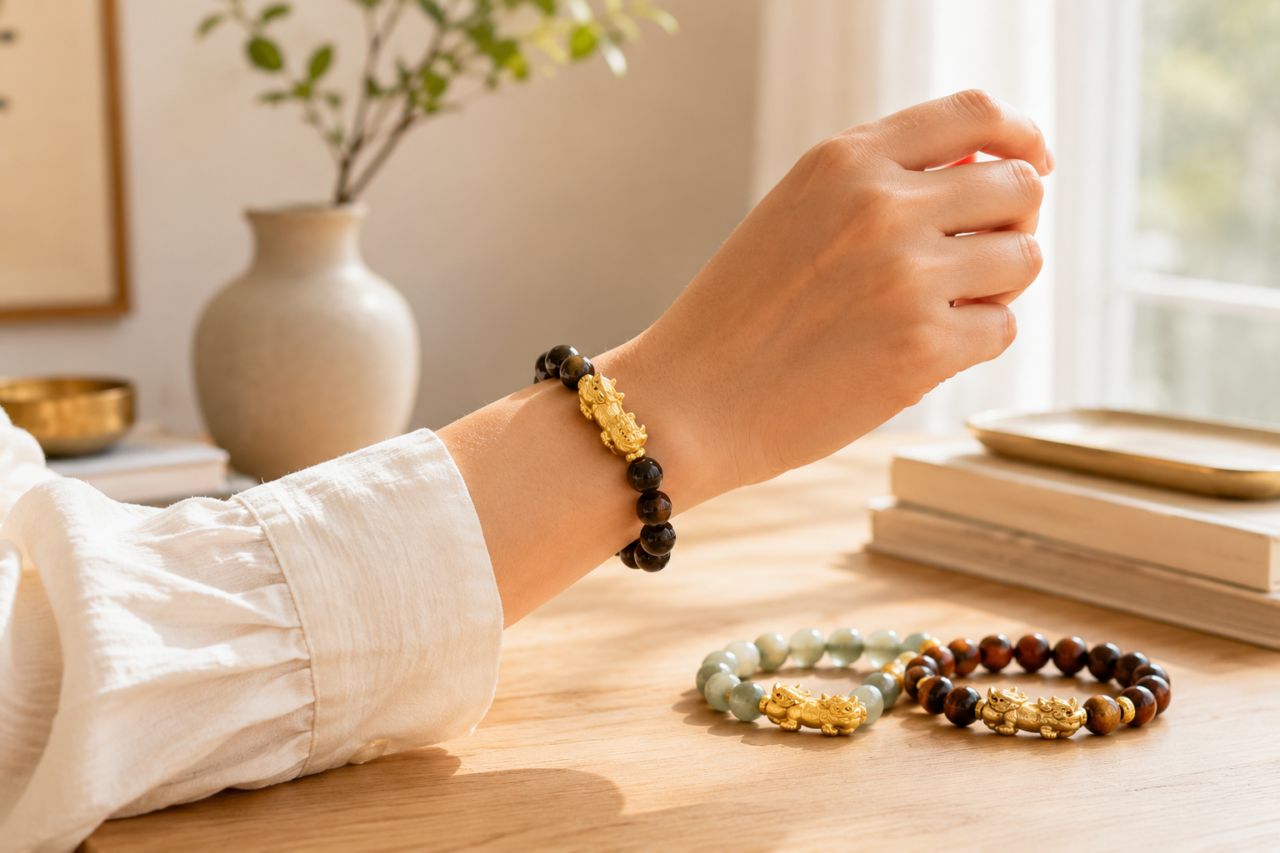
Pi Yao or Pi Xiu bracelets
Pi Yao, also known as Pi Xiu, is another popular recommendation for people who offend Tai Sui.
Many sales pages claim that wearing a Pi Yao bracelet can solve Fan Tai Sui.
This is too simple.
In modern Feng Shui practice, Pi Yao is often used as a wealth attractor. Many people associate it with attracting money, holding wealth, and improving financial luck.
But in classical Daoist and Feng Shui practice, Pi Yao also has another layer of meaning. It can be used as a protection symbol against Sha Qi, harmful influence, and negative disturbance.
That does not mean every Pi Yao bracelet is automatically a Tai Sui cure.
This is where many people misunderstand symbolic objects.
In ancient practice, a symbolic object was often the final visible form of a deeper ritual process. The object itself was not always the whole method. It often needed proper consecration, activation, prayer, talismanic empowerment, or lineage-based ritual work before it could function as a true spiritual or Feng Shui cure.
Without that process, the object may remain only a symbol.
It is like the difference between a decorative stamp and an official seal. They may look similar from the outside, but only one carries authority and function.
A Pi Yao bracelet bought online may be beautiful. It may carry cultural meaning. It may remind the wearer to stay positive and cautious.
But if it has not been properly consecrated or ritually empowered, we should not assume it can truly resolve Fan Tai Sui.
To use Pi Yao as a serious protection cure for Tai Sui, the symbol itself would need to go through a proper consecration ritual. Depending on the method, it may need to be empowered with protection work such as Five Thunder protection or a home protection talismanic method.
Otherwise, it is mostly a symbolic object.
This does not mean Pi Yao is bad.
It means we should not confuse a symbol with an activated cure.
Praying to Tai Sui
Praying to Tai Sui can be meaningful when done sincerely and properly.
In many traditions, people visit a temple at the beginning of the year to pay respect to the Tai Sui General of the year, ask for protection, reduce conflict, and seek a smoother passage through the year.
This is commonly called Bai Tai Sui.
But prayer should not be treated as a fearful transaction.
It is not simply:
“I prayed, so nothing can happen.”
Prayer is a way to show respect, align intention, seek blessing, and humble oneself before the annual authority of the year.
The sincerity matters.
The respect matters.
The way it is done also matters.
If you pray to Tai Sui, do it with a clear heart, proper respect, and a genuine wish to move through the year with more peace, awareness, protection, and better conduct.

Doing good deeds and giving charity
Doing good deeds, helping others, donating, and giving support during a Tai Sui year can also be meaningful.
This is not only moral advice.
In metaphysical thinking, giving is an outward action. It expresses Yang movement. Receiving is more Yin. When a person is going through a sensitive Tai Sui year, actively giving, helping, donating, and supporting others can help move stagnant or heavy energy outward in a more positive way.
Instead of waiting passively for luck to come, you create positive movement first.
Instead of holding fear inside, you turn the energy outward through kindness and action.
This is why donation, charity, blood donation, volunteering, helping others, and doing good deeds are often recommended during a Tai Sui year.
But again, this should not be treated mechanically.
It is not about buying luck.
It is not about making one donation and expecting Tai Sui to disappear.
It is about reducing harmful behavior, creating better karmic momentum, and moving through a sensitive year with more virtue, awareness, and restraint.
A person who offends Tai Sui should be especially careful not to create unnecessary conflict, harm others, act arrogantly, take advantage of people, or make reckless choices.
Sometimes the best Tai Sui remedy begins with behavior.
Speak less harshly.
Avoid unnecessary fights.
Drive more carefully.
Handle contracts more clearly.
Respect rules and procedures.
Take care of your health.
Do not disturb sensitive directions carelessly.
This may not sound glamorous, but it is practical.

Feng Shui restraint
One of the most important Tai Sui remedies is not adding something.
It is avoiding the wrong disturbance.
If Tai Sui or Sui Po falls in a certain part of your home, the first remedy is to keep that area calm.
Do not drill there unnecessarily.
Do not demolish there casually.
Do not start major renovation there if you can avoid it.
Do not create repeated heavy vibration in that sector.
Many people look for an object to buy, but sometimes the first and most important cure is restraint.
Do less harm first.
Then consider what support may be needed.
This is especially important because Tai Sui does not only affect people. It also affects space.
If the issue is directional, then wearing red or carrying a bracelet may not address the real problem.
If the sensitive area is being drilled, demolished, or heavily disturbed, the remedy must address the disturbance itself.

Amulets and talismans
Amulets and talismans are also commonly mentioned in Tai Sui practice.
But this is another area where confusion is common.
A generic amulet, a souvenir charm, a Tai Sui card, a temple amulet, a mass-produced bracelet, and a properly prepared Daoist talisman are not the same thing.
They may all be called “amulets” online, but they do not carry the same preparation, purpose, ritual process, or level of personalization.
This is why I do not recommend treating all Tai Sui amulets as equal.
Some objects are cultural symbols.
Some are reminders.
Some are temple-blessed items.
Some are mass-produced products.
Some are properly written, consecrated, and activated talismans prepared for a specific person, purpose, and annual condition.
These are different categories.
We will discuss this in more detail later in the article, because it deserves its own explanation.
For now, the important point is this:
A Tai Sui remedy should match the actual situation.
If the concern is zodiac-related, the method should address the person.
If the concern is space-related, the method should address the home or affected direction.
If the concern is timing-related, the method should address the timing of the action.
If the concern involves several layers at once, the remedy should be chosen more carefully.
This is why understanding Tai Sui matters before choosing a cure.
Without understanding, a remedy can become superstition.
With understanding, a remedy becomes part of proper adjustment.
Bai Tai Sui, An Tai Sui, Hua Tai Sui, and Thanking Tai Sui: What Is the Difference?

Once people begin researching Tai Sui remedies, they often come across several similar phrases:
Bai Tai Sui.
An Tai Sui.
Hua Tai Sui.
She Tai Sui, or Nip Tai Sui in Cantonese.
Thanking Tai Sui, or Send Tai Sui.
At first, these terms can sound confusing. Some temples use different names. Some local customs have slightly different procedures. Some rituals look almost identical from the outside. Because of this, beginners may wonder whether these are completely different rituals or just different ways of saying the same thing.
The answer is: both.
There are real differences in meaning, but in practical temple ritual, some of these practices may overlap.
The simplest way to understand them is this:
All of these practices are ways of respectfully responding to the annual Tai Sui energy.
They remind you that the year has changed, the annual authority has shifted, and your relationship with that yearly energy should be handled with awareness, humility, and respect.
The purpose is not only to ask for luck.
It is to recognize the upcoming changes, reduce unnecessary conflict, align yourself with the direction of the year, and move forward with greater caution and clarity.
Bai Tai Sui
Bai Tai Sui means paying respect to Tai Sui.
This is the broadest and most commonly used term. In many places, Bai Tai Sui is used as an umbrella term for annual Tai Sui-praying activities performed near the beginning of the year.
It is especially recommended for people whose zodiac signs offend Tai Sui, but it can also be performed by anyone who wants to respectfully acknowledge the Tai Sui General of the year and ask for safety, protection, blessing, and a smoother passage through the year.
Bai Tai Sui is not only about asking Tai Sui to remove problems.
It is about showing respect to the annual authority of the year.
A proper Bai Tai Sui ritual may involve offerings, incense, candles, joss paper, a Tai Sui prayer form, personal information, and prayer intention. In temples with a complete Tai Sui shrine system, people may also pay respect to Dou Mu Yuan Jun, the mother of the Tai Sui deities, the Tai Sui General of the year, and sometimes the Tai Sui of their own birth year.
The details vary by temple and local custom.
For beginners, the most practical way is to go to a temple with a Tai Sui shrine or a temple that provides Tai Sui praying services. Ask the temple staff for instructions, follow the local procedure respectfully, and focus on sincerity rather than trying to invent your own method.
Hua Tai Sui
Hua Tai Sui means resolving, transforming, or reducing the negative influence of Tai Sui.
In modern usage, Hua Tai Sui is often a simpler and more popular way of describing the act of reducing the problems caused by Fan Tai Sui.
It is commonly used when people say they want to “resolve Fan Tai Sui” or reduce the pressure of offending Tai Sui during the year.
Compared with a more complete Bai Tai Sui or She Tai Sui ritual, Hua Tai Sui may sometimes be used in a more general or layman way. It may involve prayer, offerings, a temple service, a Tai Sui prayer form, a Tai Sui talisman, or other protective methods depending on the tradition.
The important point is this:
Hua Tai Sui should not be treated as a quick magical cancellation of all problems.
To truly reduce Tai Sui pressure, the person still needs awareness, better conduct, proper timing, respect for Tai Sui and Sui Po directions, and suitable protection when necessary.
She Tai Sui / Nip Tai Sui
She Tai Sui, also called Nip Tai Sui in Cantonese, is another term often heard in relation to Fan Tai Sui.
This practice is more specifically associated with people whose zodiac signs offend Tai Sui.
The deeper meaning is not only to pray for protection, but to learn from Tai Sui, follow the way of Tai Sui, and align yourself with the wisdom of the Tai Sui General of the year.
This is an important idea.
Tai Sui is not only a force to fear.
Each Tai Sui General carries the lesson, authority, and symbolic quality of that year. To She Tai Sui is not merely to beg for safety. It is to recognize the annual authority, reduce opposition, correct one’s behavior, avoid unnecessary wrongdoing, and move with the lesson of the year instead of resisting it blindly.
In many modern temples, the ritual process of Bai Tai Sui and She Tai Sui may look very similar.
But the meaning behind the words is valuable.
Bai Tai Sui emphasizes respect and prayer.
She Tai Sui emphasizes learning, following, and harmonizing with Tai Sui’s annual way.
An Tai Sui
An Tai Sui is often translated as pacifying, settling, or securing Tai Sui.
The word An carries the meaning of settling, placing, calming, or securing. So An Tai Sui usually refers to establishing a form of annual Tai Sui support, protection, or ritual settlement.
There are generally two ways people talk about An Tai Sui:
- An Tai Sui at a temple
- An Tai Sui at home
For most people, I recommend the temple method.
At a temple, the process is usually more structured. You may register your name, birth information, address, and prayer intention. The temple may place your information in the Tai Sui ritual system, Tai Sui light, prayer list, or related annual protection service depending on local custom.
This is easier and safer for beginners because the temple already has the shrine, altar, ritual structure, and proper setting.
At-home An Tai Sui is more complicated.
Some people think they can simply place a Tai Sui tablet, Tai Sui paper, or Tai Sui altar at home and begin worship. I do not recommend this casually.
A consecrated Tai Sui tablet or Tai Sui shrine is not just a decorative object. If Tai Sui is formally invited and seated in the home or business, and incense or prayers are offered regularly, this becomes a serious spiritual and Feng Shui arrangement.
The altar location, tablet placement, relationship with the existing shrine, daily offerings, incense practice, and Feng Shui impact all matter.
If this is done incorrectly, it may create more complications than protection.
For this reason, unless you are properly trained in Daoist ritual practice and Feng Shui placement, I do not suggest casually setting up a consecrated Tai Sui altar or Tai Sui tablet at home.
For most modern readers, if you need annual Tai Sui support but do not have access to a temple or do not want to manage a complicated home altar, a properly prepared custom consecrated Tai Sui Talisman is usually a cleaner and more practical starting point.
It allows you to receive annual protection and ritual support without turning your home into a formal Tai Sui shrine.
We will discuss Tai Sui talismans more carefully later in this guide, because generic amulets, printed charms, temple talismans, and custom consecrated Daoist talismans are not the same thing.
If a Tai Sui Talisman is the option you are considering, see: When a Tai Sui Talisman May Be Helpful.
Thanking Tai Sui / Send Tai Sui
If Bai Tai Sui is performed near the beginning of the year, then Thanking Tai Sui is usually performed toward the end of the year.
This is also called Send Tai Sui.
The meaning is simple:
If you asked for protection, blessing, or support at the beginning of the year, you should return with gratitude before the year closes.
Many people remember to ask, but forget to thank.
In traditional practice, that is incomplete.
Thanking Tai Sui is the second half of the annual Tai Sui-praying cycle. It expresses gratitude to the Tai Sui of the year for protection, blessing, safety, and guidance.
As a general rule, Thanking Tai Sui is usually done from around Winter Solstice until before Li Chun of the next year. Different temples and regions may follow different customs, but the deeper principle is simple:
Thank the Tai Sui of the current year before the annual energy changes into the next year.
If you performed Bai Tai Sui, She Tai Sui, An Tai Sui, or carried a Tai Sui talisman during the year, you should pay attention to the proper closing method.
In some traditions, the Tai Sui talisman may be returned or burned with joss paper during the Thank Tai Sui ritual, depending on the method you followed.
The outer ritual may look similar to Bai Tai Sui, but the inner intention is different.
Bai Tai Sui opens the relationship.
Thanking Tai Sui completes it.
One asks with respect.
The other returns with gratitude.
If you performed Bai Tai Sui, An Tai Sui, She Tai Sui, or carried a Tai Sui talisman during the year, the closing step should not be ignored. For step-by-step instructions on timing, prayer, offerings, and proper talisman disposal, read my dedicated guide here: How to Thank Tai Sui (Send Tai Sui) – A Beginner’s Guide to Tai Sui Praying Ritual (at temple).

A Simple Way to Understand These Practices
Although there are many different names and local variations, they all share one central principle:
They are ways of respectfully responding to the annual heavenly energy.
They help you recognize the change of the year, become aware of the annual authority, align yourself with the direction and lesson of the year, and move through the year with more respect, caution, and sincerity.
A simple way to separate them is this:Practice Basic Meaning Common Timing Main Purpose Bai Tai Sui Paying respect to Tai Sui Beginning of the year Ask for protection, blessing, and smoother passage Hua Tai Sui Resolving Tai Sui pressure Beginning of the year or when needed Reduce the negative influence of Fan Tai Sui She Tai Sui / Nip Tai Sui Learning and following the way of Tai Sui Beginning of the year, especially for those offending Tai Sui Harmonize with Tai Sui and reduce mistakes or wrongdoing An Tai Sui Settling or securing Tai Sui Beginning of the year or when needed Establish annual protection or ritual support Thanking Tai Sui / Send Tai Sui Giving thanks and sending Tai Sui End of the year Close the annual Tai Sui cycle with gratitude
These practices are not meant to create fear.
They are meant to create respect, humility, protection, alignment, and completion.
What really matters is not collecting every term or obsessing over every local variation.
What matters is that you pay respect properly, understand the meaning behind the ritual, follow the correct procedure as best as you can, and move through the year with more awareness.

In the next section, we will return to the most practical Feng Shui concern for many readers:
Can you renovate in the Tai Sui or Sui Po direction?
Can You Renovate in the Tai Sui or Sui Po Direction?
This is one of the most important practical questions in annual Feng Shui.
Can you renovate in the Tai Sui or Sui Po direction?

The general answer is:
Avoid it if you can.
Tai Sui and Sui Po directions should be kept calm. These areas are sensitive because they relate to the annual authority of the year and the direction directly opposing it.
When you renovate, drill, demolish, dig, hammer, break walls, remove tiles, disturb the ground, or create strong vibration in these sectors, you are not merely using the space.
You are activating it.
And if that area happens to carry one of the most unstable annual energies of the year, this activation may pull you, your family, or the people living in that space into an unnecessary narrative of instability.
This is why traditional Feng Shui is cautious about major reconstruction in Tai Sui and Sui Po areas.
It is not because every nail, sound, or movement will automatically bring disaster.
The concern is deeper than that.
When a sensitive annual sector is strongly activated, the energy of that sector is disturbed and brought into motion. If the timing is also wrong, if the work is forceful, if the disturbance continues for a long period, or if the people involved are already sensitive to Tai Sui that year, the effect can become more obvious.
This is why some homes, buildings, stores, or even factories experience turmoil, accidents, injuries, conflict, business disruption, or unexpected problems after major renovation, construction, or ground disturbance in sensitive annual areas.
The disturbance does not always have to be inside your own living space.
Sometimes the construction is next door.
Sometimes it is in the building.
Sometimes it is from the street.
Sometimes it is from a nearby property.
If the vibration is heavy enough, if the affected sector is sensitive enough, if the timing is wrong enough, and if the people living or working there are already connected to the Tai Sui pressure of the year, the influence may still be felt.
This is where many beginners misunderstand Feng Shui.
They think:
“It is not inside my house, so it does not matter.”
But in Feng Shui, space is not always limited by walls.
Strong vibration, digging, demolition, roadwork, construction noise, and structural disturbance can still activate the surrounding field of a property. The stronger the disturbance, the more seriously it should be considered.
This does not mean every small movement in the area is dangerous.
You can still walk through the room.
You can still sleep there if it is your bedroom.
You can still sit there, clean lightly, open the window, or use the space normally.
The concern is strong disturbance.
Examples of stronger disturbance include:
- drilling into walls
- breaking walls
- demolishing cabinets
- removing floors or tiles
- digging the ground
- cutting into structural areas
- heavy hammering
- long-term construction noise
- repeated vibration
- major repair work
- beginning renovation from that sector
- nearby construction with strong vibration affecting the property
The more forceful the disturbance, the more careful you should be.
If the work is optional, postpone it.
If the work can start from another sector, start elsewhere.
If the work can be reduced, reduce it.
If the work can be scheduled more carefully, choose the timing carefully.
If the work is unavoidable, then it should not be handled casually.
This is especially important when multiple sensitive layers overlap.
For example:
If your zodiac sign offends Tai Sui, and your home renovation is in the Tai Sui or Sui Po direction, and the work begins on a sensitive Tai Sui-related day, then the situation deserves more caution.
The concern is not only one factor.
The concern is the overlap.
Many Feng Shui problems become more serious when people ignore several layers at the same time: people, space, and time.
This is why renovation during a Tai Sui year should be approached with awareness.
Not fear.
Awareness.
Before beginning work in the Tai Sui or Sui Po sector, ask:
Is this renovation truly necessary?
Can it be delayed?
Can the work start from another area?
Can the noisy or destructive part be reduced?
Can the timing be selected more carefully?
Can protection or a proper Feng Shui method be used if the work cannot be avoided?
These questions are much better than either panicking or ignoring the issue completely.
If you already disturbed the Tai Sui or Sui Po area, do not immediately assume disaster will happen.
Stop and assess the situation.
What was disturbed?
How strong was the disturbance?
Was it drilling, demolition, digging, or just light movement?
Was it in the exact sensitive sector?
Did it happen once, or repeatedly?
Was the disturbance inside your home, inside the building, next door, or nearby?
Did anything unusual happen afterward?
The response should match the level of disturbance.
A small accidental movement is not the same as major demolition.
A short repair is not the same as months of construction.
Light cleaning is not the same as breaking walls, digging into the ground, or activating the area with heavy machinery.
In the next section, I will share my practical method for handling unavoidable renovation or accidental disturbance in a Tai Sui or Sui Po area.
My Secret Cure If Renovation Is Unavoidable
In an ideal situation, you avoid disturbing the Tai Sui and Sui Po directions completely.
But real life is not always ideal.
A pipe may leak.
A roof may need repair.
A wall may already be damaged.
A neighbor may start construction.
A city project may begin on the street.
A landlord, contractor, building management, or family member may move ahead before you fully understand the Feng Shui concern.
This is why I do not like giving advice that only says:
“Do not renovate.”
That is useful when you still have a choice.
But when the work is unavoidable, you need a practical method.
The first step is always to reduce the disturbance as much as possible.
Do not make the work larger than necessary.
Do not begin from the Tai Sui or Sui Po sector if there is another option.
Do not create unnecessary noise, vibration, drilling, demolition, or ground disturbance.
Do not let children, elderly family members, sick people, pregnant women, or highly sensitive members of the household stay close to the construction area if it can be avoided.
If the work must be done, keep the affected family members away from the work area as much as possible during the strongest disturbance.
The second step is to choose timing carefully.
When you need to begin unavoidable work in a sensitive sector, avoid beginning during a Tai Sui day, Sui Po day, Tai Sui hour, or Sui Po hour whenever possible.
If you are using a simple emergency method and cannot do full date selection, one traditional timing trick I use is to begin the first disturbance during the last 20 minutes of the hour.
This is considered the weaker end of the hour in terms of energetic movement.
This is not a full replacement for proper date selection.
But when people are dealing with practical limitations, this method can help soften the sharpness of the initial activation.
The third step is to use a simple rice, salt, and water cleansing method.
Prepare:
- a small bowl of clean water
- 7 grains of raw rice
- 7 small pinches of salt
Place the 7 grains of rice and 7 pinches of salt into the water.
Before sprinkling the water into a corner, speak respectfully toward that direction first.
The wording does not need to be complicated.
The key is respect, sincerity, and clear intention.
You may simply say that repair is necessary, you do not intend disrespect, and you respectfully ask for peace, protection, and reduced disturbance for the household.
Then lightly sprinkle the water toward the four corners of the affected area, room, or home.
Do not make the area wet or messy.
This is symbolic cleansing and stabilizing, not physical washing.
If family members or people directly involved with the renovation were present during the activation, lightly sprinkle a little of the water around them or near their shoes before they leave the space.
The purpose is to reduce the energetic disturbance carried from the work area into the person.
After the cleansing is completed, leave the site for 24 hours if possible.
If the repair was major, or if the Tai Sui or Sui Po area was strongly disturbed, spending the night away from the home, such as in a hotel, is preferred.
Return the next day after the energy has settled.
Important Note for Pregnancy
If someone in the home is pregnant, extra caution is needed.
In traditional Feng Shui and spiritual practice, pregnancy is treated as a highly sensitive state. The energy of the mother and baby should be kept calm, stable, and protected.
For this reason, I do not recommend performing the rice, salt, and water cleansing method directly on a pregnant woman.
This method is meant to calm and disperse the disturbed energy field, but it can also push away spiritual disturbance. For a pregnant woman, this kind of energetic clearing may be too forceful.
In fact, if someone in the home is pregnant, you should try every possible way to avoid major reconstruction, demolition, drilling, digging, wall-breaking, or heavy vibration in the home.

Light decoration is different.
Painting may be acceptable if it is mild and properly handled.
Simple rearrangement may be acceptable if it does not involve strong disturbance.
But reconstruction is different.
You can decorate.
You can lightly adjust.
But you should not strongly disturb and activate sensitive annual sectors if there is a pregnant person in the home.
If renovation truly cannot be avoided, I would use a gentler and stronger protection approach instead.
The better method is to place a Feng Shui Renovation Protection Talisman at the home or work area, and have the pregnant woman carry or wear a Five Thunder Protection Talisman for personal protection.
This is not because we want to create fear.
It is because pregnancy deserves a higher level of caution, and the protection method should be supportive rather than forcefully cleansing.
When the Disturbance Is Stronger
If you are dealing with a large renovation, structural repair, long-term construction, major drilling, demolition, digging, or heavy vibration, the simple rice, salt, and water method may not be enough by itself.

In stronger cases, I would consider additional protection.
Another method passed down through Daoist practice is to use consecrated protection talismans during unavoidable renovation or repair.
A Feng Shui Renovation Protection Talisman may be placed in the living room or facing the reconstruction area to reduce harmful Sha Qi caused by renovation, construction, or sudden disturbance to the energy of the location.
A Five Thunder Protection Talisman may be carried by the person overseeing the repair, directly involved in the renovation, or staying in the affected environment during the repair period.
The principle is simple:
When the sensitive sector must be activated, do not leave the activation unmanaged.
Reduce the scale.
Choose the timing carefully.
Keep vulnerable people away.
Cleanse and stabilize the area when appropriate.
Leave the site afterward if possible.
Use proper protection if the disturbance is strong.
Most importantly, do not become careless just because you have used a remedy.
A remedy does not give permission to ignore Feng Shui.
It is there to reduce harm when avoidance is no longer possible.
This method is especially useful for accidental disturbance, emergency repair, unavoidable renovation, or situations where construction has already begun before you realized the Tai Sui or Sui Po concern.
It is not meant to replace a full Feng Shui assessment.
If the renovation is major, long-term, structural, or located in a highly sensitive annual sector, it is still best to consult a qualified practitioner before proceeding.
The goal is not to create fear.
The goal is to give you a practical way to respond when real life does not give you a perfect option.
[buymecoffee_button]
When a Tai Sui Talisman May Be Helpful
By this point, you should understand something important:
Tai Sui is not only about zodiac signs.
It can affect people, space, and time.
It can show up through emotional pressure, health sensitivity, unstable support, financial leakage, relationship tension, career obstacles, physical movement, relocation, renovation issues, timing conflict, or areas of life that are already sensitive.
This is why not everyone needs the same remedy.
And not everyone needs a Tai Sui Talisman.
If your life is stable, your zodiac relationship with Tai Sui is mild, your home does not disturb the Tai Sui or Sui Po direction, and you are not making major decisions, then simple awareness, respectful behavior, sincere prayer, and basic Feng Shui caution may be enough.
But some years are not that simple.
Some people enter a Tai Sui year already carrying pressure.
Maybe your health has been unstable.
Maybe your career feels blocked.
Maybe money comes in but does not stay.
Maybe your family situation is heavy.
Maybe your relationship is uncertain.
Maybe your home has Feng Shui disturbance.
Maybe you are planning renovation, moving, travel, business change, legal action, marriage, divorce, pregnancy, career transition, or another major life decision.
Maybe nothing has happened yet, but you can feel the year is not quiet.
This is when a Tai Sui Talisman may become more meaningful.
Not because you should be afraid.
But because the year may be activating several sensitive points at the same time.
Earlier, we discussed the old saying:
“When Tai Sui weighs upon a person, the year often brings either great joy or great trouble.”
This saying does not mean Tai Sui must bring disaster.
It means a Tai Sui year often carries movement.
Sometimes that movement appears as marriage, pregnancy, childbirth, relocation, promotion, business change, or a new stage of life.
Sometimes it appears as conflict, loss, emotional pressure, health sensitivity, financial leakage, unstable support, or repeated obstacles.
Sometimes both can happen in the same year.
This is why support, protection, and guidance matter more in a sensitive Tai Sui year.
A Tai Sui Talisman is not meant to stop your life from changing.
It is not meant to make you passive.
It is not meant to replace wise decisions, medical care, legal advice, financial responsibility, proper Feng Shui caution, or your own effort.
A properly prepared Tai Sui Talisman is meant to support you through the year, reduce unnecessary disturbance, strengthen annual protection, and help you move through sensitive periods with more steadiness and clarity.
Think of it as annual spiritual support for a year when the energetic weather may be unstable.
You still need to walk the path.
You still need to make decisions.
You still need to act responsibly.
But you do not need to walk into the year completely unsupported.
This talisman may be especially helpful if:
- your zodiac sign offends Tai Sui
- you feel the year may bring pressure, instability, or unexpected obstacles
- you are experiencing repeated delays, friction, or setbacks
- you are concerned about health, career, money, family, home, travel, relationship, or emotional stress
- you feel spiritually heavy, unlucky, exposed, or energetically vulnerable
- you are entering a major life transition
- your home or renovation plan involves Tai Sui, Sui Po, Five Yellow, or Three Killings concerns
- you want stronger annual protection before problems become obvious
This is not about fear.
It is about preparation.
Many people wait until problems appear before they seek help. A Tai Sui Talisman is different. It is prepared before or during the year as a form of spiritual prevention, annual protection, and energetic preparation.
You cannot control every turn of the year.
But you can choose how prepared you are when you enter it.
Explore the Custom Consecrated 2027 Tai Sui Talisman and Amulet:

Generic Amulet vs. Custom Daoist Consecrated Tai Sui Talisman
Here is where we need to be very clear.
Not all Tai Sui amulets are the same.
Online, many things are called a Tai Sui amulet, Tai Sui charm, Tai Sui bracelet, Tai Sui card, Tai Sui plaque, or Tai Sui talisman. Some look beautiful. Some are gold-plated. Some are carved on wood. Some are printed on paper. Some come with a certificate. Some are sold as if simply owning the object will automatically solve Fan Tai Sui.
This is one of the biggest misunderstandings in the modern Tai Sui market.
A talisman should not be judged only by how it looks.
A nice-looking object can still be spiritually empty.
A simple-looking paper talisman can still carry power if it is correctly prepared, consecrated, and ritually activated through an authentic method.
This is why I do not recommend choosing a Tai Sui amulet only by appearance, price, material, or advertising language.
The important question is not:
“Does it look spiritual?”
The important question is:
Was it properly prepared, consecrated, and aligned with the person who will use it?
Decorative trinkets
This is probably the most common type of Tai Sui product in the market.
It may be a bracelet, pendant, metal card, coin charm, keychain, plaque, or other polished object.

These items may be attractive. They may feel meaningful. They may remind someone to be more cautious during the year.
But if there is no proper ritual, no consecration, no lineage method, and no personal connection, then spiritually speaking, it is closer to a symbolic object than a true talisman.
There is nothing wrong with symbolic comfort.
But we should not confuse symbolism with authentic Daoist talismanic work.
Printed copies
Another common type is the printed Tai Sui talisman.
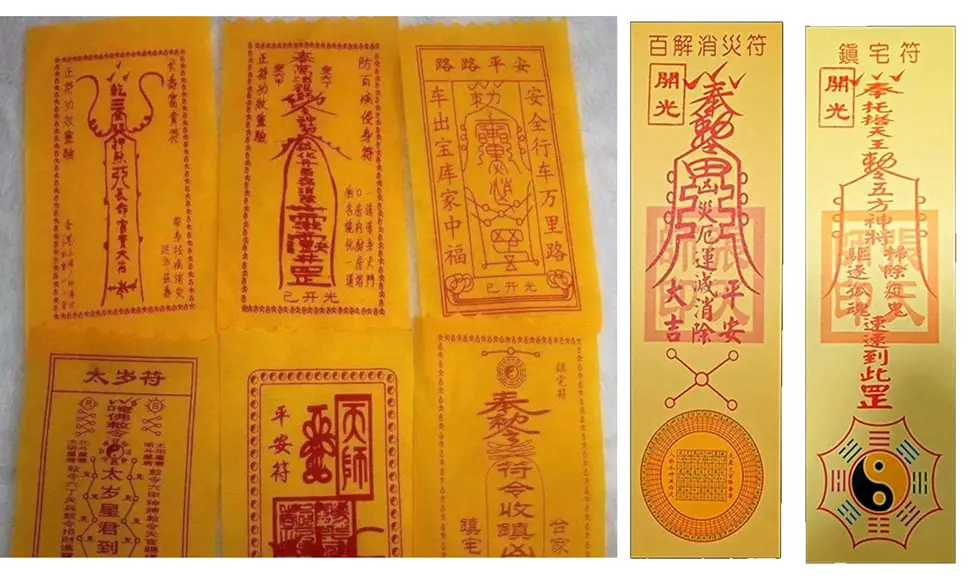
This may look more traditional because it resembles a paper talisman. But printing a talisman image is not the same as creating a talisman.
A printed copy may carry the shape of the talisman, but not necessarily the spirit, command, petition, consecration, or activation behind it.
This is important.
The power of a talisman does not come from ink alone.
It comes from the ritual authority, spiritual petition, lineage method, and activation process behind it.
Without that process, even a beautifully printed talisman may remain only a printed image.
Mass-produced temple talismans
Some temple talismans may be more meaningful than commercial trinkets or printed copies, especially when they are connected to a real temple and a proper ritual tradition.
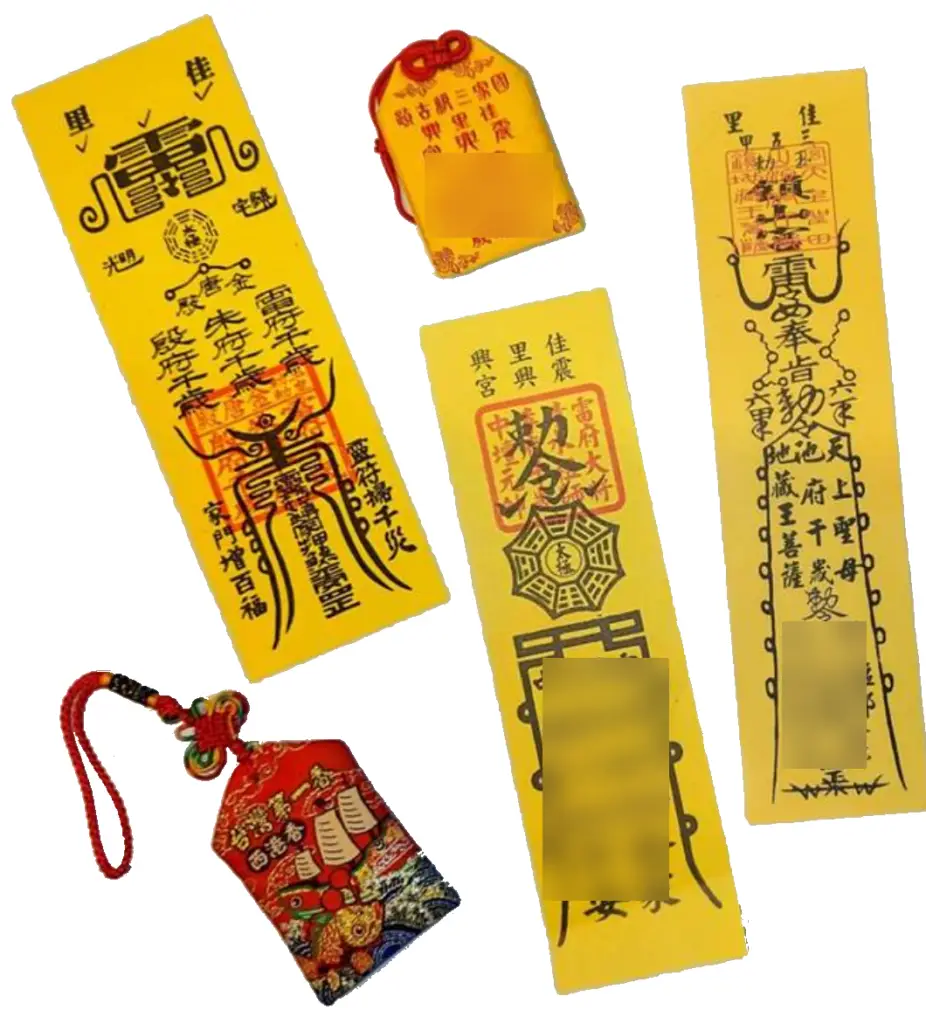
But even here, we should understand the limitation.
Many temple talismans are prepared in large batches for the public. They may carry blessing and ritual support, but they are usually not customized to one person’s birth details, current situation, home condition, personal concern, or exact relationship with Tai Sui.
For many people, this may still be useful.
But it is not the same as a fully customized Daoist consecrated talisman prepared specifically for one person.
Artistic or calligraphic talismans
Some talismans are created mainly as calligraphy or spiritual artwork.
They may look beautiful.
They may be impressive.
They may even feel powerful to the eye.
But beauty is not the same as consecration.
In practical metaphysics, aesthetics alone does not determine spiritual function. A talisman can be simple, rough, or visually imperfect, yet still be effective if it is properly consecrated. Another talisman can look elegant and refined, but remain only art if it has not been ritually activated.
This is why the outer appearance can be misleading.
Custom Daoist Consecrated Tai Sui Talisman
A custom Daoist consecrated Tai Sui Talisman is different.
It is not merely selected from stock and mailed out.
It is not a general annual charm prepared for anyone.
It is not made only to look spiritual.
A true custom talisman should be prepared with ritual method, lineage authority, personal review, clear intention, and proper consecration.
Consecration is already powerful.
Without proper consecration, even the most beautiful talisman may remain only paper and ink. Through authentic Daoist ritual, prayer, invocation, hand mudras, incantation, and spiritual sealing, the talisman is awakened and empowered.
But consecration alone is not the whole story.
What makes a talisman truly rare and personal is customization.
Because once a talisman is awakened, the next question is:
Who is it meant to recognize?
Who is it meant to protect?
What problem is it meant to address?
What year, what pressure, what life situation, what home, what intention, and what person is it being prepared for?
This is where customization becomes important.
Your name matters.
Your birth information matters.
Your current situation matters.
Your current address matters.
Your main concern matters.
Your relationship with the annual Tai Sui matters.
The reason you are seeking protection matters.
Your Heaven, Earth, and Mankind relationship matters.
In Daoist and Feng Shui practice, a person’s life is not shaped by only one force.
There is Heaven — your birth chart, inherited destiny, annual Tai Sui influence, timing, and the spiritual pattern of the year.
There is Earth — your home, workplace, Feng Shui environment, direction, location, and the energy field surrounding you.
There is Mankind — your choices, behavior, effort, relationships, decisions, emotions, and how you respond to the year.

A custom Tai Sui Talisman should not be prepared by looking at only one of these layers.
If someone is facing health pressure, the talisman should not be treated the same as someone facing career betrayal.
If someone is dealing with money leakage, the preparation should not be the same as someone facing legal trouble, family conflict, renovation disturbance, pregnancy concerns, relocation, or emotional heaviness.
If someone’s home is also connected to the Tai Sui or Sui Po direction, that situation should be understood differently from someone whose concern is only zodiac-related.
This is why I do not treat customization as simply writing your name on a talisman.
That is surface personalization.
True customization means I take time to understand the person, the situation, the concern, and the energetic pattern behind the request, so the talisman can be prepared with the right focus.
Sometimes a person comes to me saying:
“I need Tai Sui protection.”
But after understanding the situation more carefully, the real concern may be unstable health, lack of support, home disturbance, career pressure, family tension, money leakage, or a major life transition.
The talisman still protects against Tai Sui pressure, but the prayer, petition, focus, and spiritual request can be adjusted to speak more directly to the person’s actual path through the year.
That is the difference between a general magic tool and a tailored spiritual protection armor.
A generic amulet may say:
“This is for the Tai Sui year.”
A custom Daoist consecrated talisman says:
“This is for you, in this Tai Sui year, with this concern, this path, and this need for protection.”
That difference matters.
Because when Tai Sui affects people, space, and time, the support should not be blind or generic.
It should be personal.
It should be prepared with understanding.
It should carry not only spiritual power, but direction.
This is why a properly customized Tai Sui Talisman is not only a talisman.
It becomes a sacred support prepared for your year, your pressure, your transition, your protection, and your path forward.Type What It Usually Offers Main Limitation Decorative trinket Symbolic comfort or reminder Usually no real consecration or personal connection Printed copy Traditional-looking talisman image Shape without necessarily carrying ritual activation Mass-produced temple talisman General blessing or temple support Usually not customized to your personal situation Artistic talisman Visual beauty or calligraphic value Appearance does not guarantee spiritual function Custom Daoist consecrated talisman Personal review, ritual petition, consecration, customization, and annual support Requires proper practitioner, lineage, time, and care
This is why a Tai Sui Talisman should not be chosen casually.
If the year is light for you, a symbolic object may be enough.
If the year is truly sensitive, especially when people, space, and time overlap, then a generic object may not be sufficient.
In that case, the value is not in the paper alone.
The value is in the ritual.
The value is in the petition.
The value is in the lineage.
The value is in the customization.
The value is in the fact that the talisman is prepared for you, not for a faceless crowd.
What Makes My Tai Sui Talisman Preparation Different
I do not treat a Tai Sui Talisman as a product sitting on a shelf.
I treat it as a spiritual work prepared for a real person entering a real year with real concerns.
That difference matters.
Many standard annual amulets are made in advance. The buyer places an order, the item is packed, and it is shipped. There may be meaning in that, but it is still general.
A Tai Sui year does not affect everyone in the same way.
For one person, the pressure may appear through health.
For another, through career.
For another, through money, family, home, relationship, travel, legal matters, emotional stress, renovation, or spiritual disturbance.
This is why I do not believe a serious Tai Sui Talisman should be treated as one-size-fits-all.
A proper talisman should be prepared for the person.
Not only for the year.
The first layer: listening and understanding
Before the talisman is prepared, I first try to understand your actual situation.
This may include:
- your name
- your birth information
- your zodiac relationship with Tai Sui
- your current address or living environment
- your main concern for the year
- your current life pressure
- your intention for protection, stability, or support
- whether your concern is related to health, career, money, family, home, relationship, travel, renovation, emotional heaviness, or spiritual unease
This is not because I want to collect information for the sake of formality.
It is because the talisman should know who it is serving and what kind of annual pressure it is meant to address.
Sometimes the most important part of customization is not writing.
It is listening.
A person may say, “I need Tai Sui protection,” but behind that sentence there may be years of health pressure, repeated career blocks, family heaviness, financial leakage, home disturbance, emotional exhaustion, or the feeling that something unseen keeps holding them back.
If I do not understand the concern, the talisman may still be powerful, but it may not be as precise.
That is why I go the extra mile to learn the story, the concern, and the context.
The more clearly the situation is understood, the better the talisman can be tailored.
Learn more about personalized Tai Sui protection:

The second layer: Heaven, Earth, and Mankind
In Daoist and Feng Shui practice, a person’s life is not shaped by only one factor.
There is Heaven.
There is Earth.
There is Mankind.
Heaven includes your natal chart, inherited destiny, annual Tai Sui influence, zodiac relationship, timing, and spiritual pattern of the year.
Earth includes your home, environment, Feng Shui condition, location, direction, and surrounding energy field.
Mankind includes your decisions, actions, behavior, relationships, intention, effort, and the way you respond to the year.
A customized Tai Sui Talisman works best when these three layers are understood together.
This is why the preparation is not only about writing a symbol.
It is about understanding how the year may affect you personally.
The third layer: natal chart review and practical adjustment
When appropriate, I also review the natal chart to understand the person’s inherent energetic tendencies, strengths, vulnerabilities, and possible blockages.
This matters because Tai Sui does not affect everyone in the same way.
For some people, the yearly pressure may touch health.
For others, career.
For others, relationship, money, family, home, travel, emotional stability, or spiritual heaviness.
A natal chart can reveal where the deeper sensitivity may already exist.
This allows the talisman preparation to become more focused.
It may also allow me to provide practical guidance when needed, such as environmental rearrangement suggestions, Feng Shui cautions, or natal-chart-based blockage cleansing methods that support the talisman’s purpose.
This is important.
The talisman is powerful, but it does not mean practical adjustment becomes unnecessary.
If the Earth aspect is disturbed, the environment may need attention.
If the Mankind aspect is creating conflict, behavior and decision-making may need adjustment.
If the Heaven aspect shows a sensitive pattern, spiritual protection and timing may need to be handled more carefully.
This is why I do not only provide a talisman.
I try to provide a practical support system around it when the situation calls for it.
The fourth layer: auspicious timing and focused petition
A talisman should not be prepared casually.
Timing matters.
Just as we discussed earlier, the starting time of an important action gives that action its own energetic pattern. Preparing a talisman is also an event. It requires proper timing, concentration, and ritual flow.
A focused petition is prepared for your situation.
Your name, birth details, intention, and concern are respectfully presented in the spiritual report. This is not a general blessing for anyone. It is a direct request for support based on your path through the year.
This is the point where the talisman begins to become personal.
The fifth layer: authentic Daoist consecration
Before a talisman can truly function, it must be consecrated.
Without proper consecration, even the most beautiful talisman remains only paper and ink.
In authentic Daoist talisman practice, consecration is the process that awakens, activates, seals, and empowers the talisman through lineage method. It involves ritual preparation, prayer, invocation, hand mudras, incantation, sealing, and spiritual authority.
Every step matters.
The pronunciation matters.
The rhythm matters.
The sequence matters.
The intention matters.
The lineage authority matters.
This is why a talisman cannot be mass-produced casually and still be treated as the same thing as a properly consecrated work.
Belief is important.
But belief alone is not enough.
In metaphysical practice, belief is like the Yang side. It must be supported by the Yin side: the actual ritual structure, method, preparation, and spiritual process that allows the talisman to hold and communicate its function.
Without that process, there may be emotion, hope, and symbolism.
But there may not be real talismanic function.

The sixth layer: guidance after receiving the talisman
A Tai Sui Talisman is not meant to be received and forgotten.
How you carry it matters.
How you treat it matters.
How you pray with it matters.
How you keep it clean matters.
How you dispose of it at the end of the year matters.
This is why guidance is part of the process.
After receiving the talisman, you are not only receiving an object. You are beginning a spiritual relationship with a talisman prepared for your year.
I will guide you on how to connect with it properly.
This may include how to carry it, where to keep it, what to avoid, how to pray with it, how to set your intention, and how to build a simple daily routine around it.
This daily prayer or routine does not need to be complicated.
The goal is not to burden you.
The goal is to help you cultivate the talisman and allow it to resonate with you spiritually.
The more sincerely and respectfully you work with it, the more it becomes your own.
Not just a Tai Sui Talisman.
Not just a ritual object.
But a one-of-a-kind personal spiritual tool prepared for your path through the year.
What this means for you
If you are looking only for a beautiful object, this may not be what you need.
If you are looking for a casual lucky charm, this may not be what you need.
If you simply want something inexpensive to make you feel better for a moment, a generic amulet may be enough.
But if you are entering a Tai Sui year with real concern, real pressure, real transition, or real instability, then you may need something prepared with more care.
My talismans are not for everyone.
They are for those who take the year seriously.
They are for those who have worked hard, made efforts, carried responsibilities, and still feel that unseen barriers are pressing against them.
They are for those who do not want to walk into a sensitive year empty-handed.
They are for those who understand that protection is not weakness.
It is preparation.
A Tai Sui Talisman does not replace your effort.
It stands beside it.
It does not erase your struggle.
It helps you move through it with more support.
It does not promise that nothing difficult will ever happen.
It helps soften unnecessary friction, strengthen spiritual protection, and support a steadier path through the year.
That is the difference between buying an object and receiving a prepared talisman.
One is a thing.
The other is a spiritual work made for your year.
For personalized annual protection prepared around your birth details, current circumstances, and primary concerns, explore my Custom Consecrated 2027 Tai Sui Talisman and Amulet.
For a deeper explanation of why personalization matters in authentic talismanic work, read: When the Divine Becomes Personal – Beyond the Ordinary Talisman and the Power of True Customization.
Where to Go Next: Current-Year Guides and Talisman Resources
By now, you should have a clearer understanding of Tai Sui.
Tai Sui is not only a zodiac warning.
It is not only a direction.
It is not only a superstition.
It is a layered annual system that can affect people, space, and time.
If you only needed the foundation, this guide may already be enough.
But if you want to apply this knowledge to the current year, perform a ritual properly, prepare for a sensitive Tai Sui year, or choose the right protection method, the next step is to use the right resource for your situation.
Below are the guides and resources I recommend.If You Want To Understand… Read This The full current-year Tai Sui details Complete 2027 Tai Sui and Fan Tai Sui Guide A simpler introduction to 2027 Tai Sui, Sui Po, and Bai Tai Sui The Beginner’s Guide to Tai Sui, Sui Po, and Bai Tai Sui for 2027 The complete annual home Feng Shui arrangement 2027 Flying Star Feng Shui Guide How to pray to Tai Sui at a temple How to Bai Tai Sui – Beginner’s Guide How to thank and send Tai Sui properly at the end of the year How to Thank Tai Sui – Beginner’s Guide How to choose a real Tai Sui amulet or talisman Best Tai Sui Amulet and Talisman Guide Why customization matters in talisman work When the Divine Becomes Personal Personalized annual Tai Sui protection Custom Consecrated Tai Sui Talisman and Amulet 2027 Tai Sui and Sui Po remedies and renovation cautions 2027 Tai Sui & Sui Po Remedies and Renovation Cautions
If you are here only to learn, begin with the current-year Tai Sui guide.
If you are planning renovation, repair, moving, or construction, pay special attention to the annual Feng Shui and renovation sections.
If your zodiac sign offends Tai Sui and you are already facing pressure, uncertainty, emotional heaviness, career blockage, money leakage, health sensitivity, family matters, home disturbance, or major life transition, then read the Tai Sui Talisman guide before deciding what kind of protection is appropriate.
Do not rush.
Do not panic.
Do not buy something only because a website frightened you.
Understand the situation first.
Then choose the method that genuinely matches your needs.
That is the whole purpose of this Tai Sui hub.
To help you see clearly.
To help you act wisely.
And to help you move through the year with more calmness, preparation, and protection.
Final Clarifications: Questions Readers Still Ask About Tai Sui
By now, you should understand the main structure of Tai Sui: people, space, and time.
Still, real life is not always clean and simple.
A person may not offend Tai Sui by zodiac sign, but still feel the year is difficult.
A person may offend Tai Sui, but nothing obvious may happen at first.
A house may have an auspicious Flying Star in one sector, but that same sector may also overlap with Tai Sui, Sui Po, Three Killings, Five Yellow, or another annual affliction.
A person may already have prayed to Tai Sui, but still wonder whether a talisman is needed.
This final section is here to answer some of those practical questions.
What if my zodiac sign does not offend Tai Sui, but my year still feels difficult?
This can happen.
Your zodiac sign is only one layer. Tai Sui is an annual influence, but it is not the only force shaping your year.
A person’s life is affected by Heaven, Earth, and Mankind.
Heaven includes your natal chart, karma, timing, and inherited energetic structure. Tai Sui is only a temporary annual energy passing through your deeper birth chart. Your birth month, birth date, birth hour, elemental distribution, and inherent energetic patterns may already contain certain blocks, pressure, or opportunities.
Earth includes your Feng Shui environment: your home, business place, working environment, land, direction, layout, and the energy field surrounding you. Sometimes the difficulty does not come from zodiac Tai Sui at all. It may come from the house, the office, an annual Flying Star, Five Yellow, Three Killings, poor forms, or disturbed energy in your living environment.
Mankind includes your effort, choices, behavior, relationships, emotional state, family support, friends, colleagues, supervisors, clients, and the people field around you. Sometimes your personal effort is strong, but your support field is weak. Sometimes the environment is good, but decisions are rushed. Sometimes your natal chart has potential, but the people around you are draining your momentum.
This is why I do not recommend judging the whole year only by zodiac sign.
If your zodiac sign does not offend Tai Sui but your year still feels unusually heavy, look at the broader picture.
Your issue may not be Fan Tai Sui.
It may be your natal chart.
It may be your home.
It may be your timing.
It may be the people around you.
It may be the way several layers are interacting at once.
What if my zodiac sign offends Tai Sui, but nothing bad has happened?
That is possible too.
Fan Tai Sui does not guarantee obvious disaster. It means your relationship with the annual energy is more sensitive.
Sometimes the effect is strong and visible.
Sometimes it is subtle.
Sometimes it does not appear as one dramatic event, but as a shift in a specific life field.
For example, it may affect your property or investment field. Your house may need extra maintenance that year. You may have unexpected repair costs, rental issues, property decisions, or household concerns.
It may affect the way your mind works. You may start learning something new, questioning old beliefs, seeing things differently, or entering a period of inner awakening.
It may affect your network field. You may meet new people, leave old relationships, enter a new circle, start a new journey, or slowly disconnect from people who no longer belong to your path.
It may also affect your family field.
Because we are not isolated. We are interconnected.
Sometimes your Tai Sui pressure reflects more through your parents, spouse, partner, children, siblings, or people closely tied to you. How obvious that becomes depends on their own natal chart, their living environment, and their personal situation.
So if your zodiac sign offends Tai Sui but nothing bad has happened, do not create fear for yourself.
Stay aware.
Observe where movement is happening.
Avoid unnecessary risk.
Keep your Tai Sui and Sui Po directions calm.
And remember: not every Tai Sui effect appears as “bad luck.” Sometimes it appears as learning, transition, new awareness, changing relationships, property matters, or shifts in the people connected to you.
What if Tai Sui overlaps with Five Yellow, Three Killings, or a difficult Flying Star?
This is when annual Feng Shui becomes more important.
One annual affliction by itself may already require caution. When several annual influences overlap in the same sector, that area becomes more sensitive.
The question is no longer simply:
“Is this sector good or bad?”
A better question is:
What energies are overlapping here, and how should I handle this sector safely?
For example, if Tai Sui overlaps with Three Killings, you should be more careful with renovation, drilling, digging, demolition, heavy movement, or repeated vibration in that area.
If a sector has Five Yellow, the priority is to keep it calm, clean, quiet, and avoid activating it with fire, earth, reconstruction, heavy vibration, or long periods of disturbance.
If a sector has an auspicious Flying Star but also overlaps with Tai Sui, Sui Po, Three Killings, or Five Yellow, do not activate it aggressively. Support it gently.
This is very important.
A good star does not always mean you can strongly activate the area.
If the sector is also afflicted, the method must be balanced.
You may still support the auspicious potential, but you should not disturb the annual authority or trigger the negative affliction.
This is why annual Feng Shui cannot be reduced to one chart, one object, or one rule.
You need to understand the overlap.
Which matters more: my zodiac sign or my home’s Tai Sui direction?
They matter in different ways.
Your zodiac sign belongs to the people layer.
Your home’s Tai Sui direction belongs to the space layer.
Neither should automatically cancel the other.
Your life is complex. The outcome of a year is not determined by one single factor.
If your zodiac sign offends Tai Sui, you should be personally more cautious.
If your home’s Tai Sui or Sui Po sector is disturbed, the household or people using that space may be affected.
If your natal chart is already sensitive, the annual Tai Sui may activate deeper issues.
If your family, work, or relationship field is unstable, the Mankind layer may also contribute to the pressure.
The strongest concern often appears when multiple layers overlap.
For example, if your zodiac sign offends Tai Sui, your bedroom or main entrance falls in the Tai Sui or Sui Po direction, and you are also planning renovation during sensitive timing, then the situation deserves much more careful handling.
In that case, the solution should match the layer.
Personal concern may need personal protection.
Home disturbance may need Feng Shui correction.
Timing concern may need date selection.
Natal chart sensitivity may need deeper analysis.
A Tai Sui Talisman may support the person, but it does not replace proper Feng Shui handling of the home. Likewise, a home cure may stabilize the space, but it does not always address the individual’s personal Tai Sui pressure.
The method should fit the problem.
Should I worry if my neighbor is renovating in my Tai Sui direction?
Not every neighbor’s renovation will affect you.
But it can matter if the construction is close enough, loud enough, forceful enough, or creates strong vibration that reaches your home.
In Feng Shui, walls do not completely block the influence of heavy disturbance. Roadwork, nearby demolition, digging, drilling, hammering, or major construction can still activate the surrounding field of a property.
The level of concern depends on several factors:
- how close the construction is
- how strong the vibration is
- whether it falls in a sensitive annual sector
- how long the work continues
- whether your household is already sensitive that year
- whether unusual problems appear after the disturbance begins
A small repair next door is not the same as months of heavy construction.
The response should match the level of disturbance.
Do not rush to panic.
First, assess the situation.
If the work is minor, temporary, and not strongly affecting your home, basic caution may be enough.
If the construction is strong, ongoing, and clearly activating your Tai Sui, Sui Po, Three Killings, or Five Yellow sector, then a stronger protection method may be appropriate.
In that situation, a Feng Shui Renovation Protection Talisman may be considered for space disturbance caused by construction, drilling, renovation, or vibration. A Five Thunder Protection Talisman may also be considered if the disturbed energy is affecting the household or if the area is frequently used.
But the principle is not to buy many things out of fear.
The principle is to choose the correct method for the level and type of disturbance.
Can I still travel, move, get married, start a business, or have a baby during a Tai Sui year?
Yes.
A Tai Sui year does not mean life must stop.
People still get married, give birth, move homes, change jobs, start businesses, travel, and enter new stages of life during Tai Sui years.
The key is not to avoid life.
The key is to avoid careless action.
Tai Sui often brings movement. Sometimes that movement is necessary. Sometimes it is even positive.
But movement during a Tai Sui year should be handled with more awareness.
If the event is important, choose the date carefully.
If the home is involved, check the Feng Shui sectors carefully.
If your zodiac sign also offends Tai Sui, consider whether additional protection or guidance is needed.
A Tai Sui year does not forbid major life events.
It asks you to prepare better before entering them.
Do I need a Tai Sui Talisman if I already prayed to Tai Sui?
Not always.
Bai Tai Sui and a Tai Sui Talisman are related, but they are not exactly the same.
Bai Tai Sui is a ritual of respect, prayer, humility, and alignment.
When you pray to Tai Sui, you are mentally and spiritually acknowledging the annual authority of the year. You are reminding yourself to be aware of the upcoming energy, to act with more caution, and to align yourself with the teaching and direction of the year.
This is already meaningful.
A consecrated Tai Sui Talisman provides another layer.
It is a form of ongoing spiritual support that you carry or keep with you throughout the year.
A custom consecrated Tai Sui Talisman goes even further because it is prepared according to your personal information, your concern, your relationship with the year, and the specific challenge you are facing.
The purpose is not only to “block bad luck.”
It is to soften obstacles, reduce unnecessary disturbance, minimize the negative impact of Tai Sui pressure, and help you move more steadily toward the opportunities that the year may also bring.
If your situation is mild, sincere Bai Tai Sui may be enough.
If your situation is more layered—such as strong zodiac conflict, repeated obstacles, health pressure, emotional heaviness, renovation disturbance, major transition, family stress, financial leakage, or unstable support—a properly prepared Tai Sui Talisman may provide additional protection and support.
The method should match the situation.
Can one Tai Sui Talisman protect my whole family?
A personal Tai Sui Talisman is usually prepared for one person.
That is because the person’s name, birth information, zodiac relationship, concern, and intention matter. A custom talisman is meant to recognize and support the specific individual it is prepared for.
If the concern is household-related, then the method should be different.
For example, if the issue is home disturbance, renovation, Five Yellow, Three Killings, Sui Po, or general household protection, a home-based Feng Shui protection method may be more appropriate.
In some cases, both personal and home protection may be used together.
A person who offends Tai Sui may carry a personal Tai Sui Talisman, while the home may need a stronger Feng Shui cure or protection method if the space itself is disturbed.
For general household protection, a Five Thunder Protection Talisman or Home Protection Talisman may be more suitable.
For renovation, construction, drilling, wall-breaking, or accidental activation of an afflicted sector, a Feng Shui Renovation Protection Talisman is more specific.
But again, the answer is not to use everything at once.
Personal issues and house issues should not be treated as the same thing.
Choose the method according to the layer being affected.
Person.
Space.
Timing.
Home.
Renovation.
Each has its own logic.
When should I get Tai Sui protection: before the year begins or after problems appear?
Ideally, before the year becomes difficult.
Tai Sui protection is usually more useful as preparation than as a last-minute reaction.
If you already know your zodiac sign offends Tai Sui, your home has sensitive annual sectors, or you are entering a year with major decisions, relocation, renovation, health pressure, career instability, family concerns, or emotional heaviness, it is better to prepare early.
That does not mean it is useless later in the year.
If problems have already appeared, protection may still help stabilize the situation, reduce further disturbance, and prevent the damage from expanding.
Sometimes people only seek help after things begin to go wrong.
At that point, the goal is no longer only prevention.
The goal is also containment.
Stabilize what can be stabilized.
Reduce what can be reduced.
Protect what can still be protected.
But in general, prevention is better than repair.
What should I do if I still do not know what applies to me?
Start with the three layers.
Ask yourself:
Does this concern relate to me personally?
Does it relate to my home or space?
Does it relate to timing or an important event?
Then look at what is actually happening in your life.
Are you dealing with health pressure, career blockage, financial leakage, emotional heaviness, renovation, relationship instability, family matters, travel, legal concerns, or major life transition?
If your situation is simple, the general guidance in this article may be enough.
If your situation is layered, sensitive, or already unstable, personalized guidance may be more appropriate.
You do not need to panic.
But you also do not need to guess blindly.
If you are unsure which part of Tai Sui applies to you, or what level of remedy is suitable, you may reach out to Master Willow for guidance.
Sometimes the most important step is not immediately buying a cure.
It is understanding the real problem first.
Contact Master Willow: [email protected]
About Master Willow
Perhaps you have experienced this yourself.
You first discover Feng Shui because you want an answer.
Then you begin reading.
One expert tells you the front door is the most important factor.
Another tells you to follow your personal favorable directions.
Then you learn Eight Mansions, San Yuan, Xuan Kong, BaZi, annual Feng Shui, date selection, or another system—and suddenly the same house can appear auspicious under one method and problematic under another.
So you study more.
But instead of becoming clearer, the rules become narrower.
One method tells you not to sleep here.
Another tells you not to work there.
One direction is unfavorable to your personal chart.
Another sector has an annual affliction.
Another school says the Qi itself is untimely.
Eventually, it can feel as though every direction has a problem, every choice breaks a rule, and the more Feng Shui you learn, the less freedom you have to actually make a decision.
For serious students and practitioners, the frustration can go even deeper.
You may have studied several schools.
You may know how to calculate charts.
You may have read books, taken courses, followed different masters, and researched extensively on your own.
Yet when two methods conflict, you still face the same questions:
Which one should I follow?
Which one has priority?
Can these practices be used together?
Why did a method that was supposed to work produce little or no noticeable result?
And what can I simply ignore?
I understand that confusion very well.
Because those were my questions twenty years ago.
I Did Not Need Another Formula. I Needed to Understand the Whole.
I began studying the I Ching and Chinese metaphysics as a teenager.
Over the years, I studied with nearly thirty teachers and invested an amount comparable to the down payment on a decent house into my training.
In my earlier years alone, I studied at least four different Flying Star schools.
Later, in Qi Men Dun Jia, I studied more than six different approaches—from Yin and Yang charts, natal-chart arrangements and Feng Shui applications, to spiritual and magical practices.
And the deeper I went, the more I realized another difficulty.
Traditional knowledge is not always transmitted as one complete and transparent system.
Some rules are hidden within lineages.
Some methods are taught only after years of study.
Some secrets have historically been kept closely within a school or teacher-student relationship.
And because of differences in transmission, interpretation, lineage, and even competition, two practitioners who appear to study the same system may still reach very different conclusions.
There are practices that can produce striking results.
But knowing a powerful method is only one part of the problem.
The harder questions are:
When should you use it?
What conditions must be present?
What are its limitations?
What happens when it appears to conflict with another method you have learned?
And most importantly:
Which factor actually deserves priority in the situation in front of you?
This is where collecting more techniques is no longer enough.
You need to understand the different practices systematically as a whole.
That became the turning point in my own study.
Different Methods Are Not Always Answering the Same Question
I eventually stopped asking:
“Which school is right?”
and began asking:
“What is this method actually measuring?”
Different practices may examine different aspects of a property or different layers of the same situation.
One method may focus primarily on landform.
Another may examine the purity or quality of Qi.
Another may ask whether that Qi is timely.
Another may be concerned with the person.
One method may be most appropriate under ideal conditions, while another becomes more useful when those ideal conditions do not exist.
One practice may focus primarily on financial outcome.
Another may place greater emphasis on health.
So two methods can appear to contradict one another while actually addressing different questions.
And sometimes a method is not wrong.
It is simply being given too much importance.
That is one of the biggest sources of confusion in Feng Shui.
People learn methods.
But they are rarely taught how to organize them.
They learn rules.
But not hierarchy.
They learn what to calculate.
But not what deserves priority.
My later research and deeper classical study gradually allowed me to develop a more systematic way of understanding how these practices relate, where each belongs, and how they can be integrated organically rather than forced together.
The questions I now ask are:
What is the real problem?
What is this method actually measuring?
What level of the situation are we examining?
Which factor is primary?
Which one is secondary?
What can be adjusted?
What cannot be changed?
And what can be safely ignored?
That is the foundation of how I now approach Feng Shui.
Sometimes the Best Advice Is What You No Longer Need to Worry About
Many clients come to me after reading too much.
They have already been told that the door is wrong.
The bedroom is wrong.
The direction is wrong.
The Flying Star is wrong.
The annual energy is wrong.
Their personal chart says something else.
And by the time they ask for help, they are no longer looking for another rule.
They are looking for clarity.
Sometimes the most important thing I tell a client is:
You do not need to worry about this.
Sometimes:
This factor is real, but it is secondary.
Sometimes:
Do not spend your energy fixing this yet. The more important issue is somewhere else.
Sometimes:
These two practices are not actually contradicting each other. They are looking at different parts of the problem.
And sometimes:
Yes, this is the issue that deserves priority. Let us focus here first.
That is often where relief begins.
Because good Feng Shui should not leave you feeling that everything is wrong.
It should help you understand:
what matters
why it matters
what should be addressed first
what can wait
and
what you can finally stop worrying about
The goal is not to use more Feng Shui.
The goal is to use the right Feng Shui for the right problem.
A Systematic Approach to the Situation in Front of You
When I examine a Feng Shui problem, I do not begin by forcing the situation into my favorite formula.
I begin with the situation itself.
What are we actually trying to understand or improve?
Then I use several classical frameworks to organize what might otherwise appear to be a collection of conflicting methods.
Form and Qi, Substance and Application
Form and Qi, and Substance and Application, are both deductions from the fundamental principle of Yin and Yang.
They help us understand relationships and establish priority.
What is fundamental, and what is its expression?
What is creating the condition, and what is responding to it?
What is primary in this case, and what is secondary?
A method may be valid, but if it addresses only a secondary factor while the primary problem remains untouched, the result may be limited.
A powerful technique may work very well—but only under the right conditions.
A cure may be useful—but only after the real source of the problem has been identified.
This is why simply applying more Feng Shui methods does not necessarily produce a better outcome.
The first question should not be:
“Which cure should we use?”
It should be:
“What is actually happening?”
Heaven, Mankind, and Earth
The next framework is Heaven, Mankind, and Earth.
In traditional Chinese metaphysics, these are three fundamental forces shaping a person’s life.
Heaven represents factors that are largely fixed or inherited—such as birth timing, ancestry, destiny, and the conditions you are born into.
Mankind represents the human variable—your actions, relationships, daily choices, current circumstances, and the karma you continue to create through the way you live.
Earth represents the environment in which your life unfolds—your home, workplace, land, surroundings, and Feng Shui.
This framework helps us separate the constants from the variables.
What is fixed and cannot simply be changed?
What remains uncertain or still has room to move?
And most importantly:
What can we actually do to improve the outcome?
You may not be able to change your birth time.
You may not be able to rewrite your ancestry or every condition you inherited.
But you can change how you respond.
You can make different decisions.
You can improve relationships.
You can choose better timing.
You can adjust the environment in which you live and work.
Once we understand what is fixed and what remains variable, we can stop wasting energy trying to change what cannot be changed and focus more effectively on the areas where meaningful improvement is actually possible.
This helps us ask:
What must be understood?
What can be changed?
Where do we still have influence?
And where should our effort be directed first?
Combined with Form and Qi and Substance and Application, this gives us a clearer way to understand the structure of a case, establish priority, and apply the right method where it can have the greatest effect.
This is how I determine:
what deserves priority
which practices can work together
which factor is secondary
what can realistically be changed
and
which information is simply not relevant to the situation
For a client, this can prevent unnecessary fear, unnecessary cures, unnecessary renovation, and expensive changes aimed at the wrong problem.
For a serious student, it can transform Feng Shui from a growing collection of restrictions into a more coherent way of understanding how the pieces actually fit together.
What This Means for You
You do not need someone to make Feng Shui more complicated.
There is already enough conflicting information available.
What you may need is someone who can help you separate:
the important from the secondary
the relevant from the irrelevant
the underlying principle from the surface formula
the real concern from unnecessary fear
and
the method that fits your situation from the method you can completely ignore
For a homeowner or business owner, this may mean avoiding expensive changes that solve the wrong problem.
For someone planning a property purchase, renovation, move, or major decision, it may mean knowing what genuinely deserves caution before acting.
For someone who has already studied Feng Shui, it may mean finally understanding why different systems appear to conflict—and learning how to establish priority instead of adding another layer of confusion.
The objective is not to give you more rules.
It is to give you better judgment, clearer priorities, and greater confidence in the decisions you make.
My Classical Feng Shui and Daoist Background
I am Willow Leo, founder of Feng Shui Digest. Many readers and clients know me as Master Willow.
My Feng Shui work is rooted in classical lineage and traditional study.
I am a 40th-generation holder of the Yang Gong lineage, with training and practice that include Xuan Kong Liu Fa, Xuan Kong Da Gua, Classical Form School, and other traditional systems concerned with land, form, Qi, direction, timing, and human application.
My Daoist work comes through authentic lineage training and includes Quan Zhen lineage Daoist magic and ritual practice, together with important traditional lineages and methods including Mao Shan practices, Hua Guang magic, Emperor magic, and additional traditional talismanic and spiritual work.
My broader study has also included Qi Men Dun Jia, the 64 Trigrams, annual Feng Shui, modern and classical astrology, celestial activation, date selection, classical metaphysics, and other specialized practices.
But I do not believe the value of this training lies in how many systems I can list.
Its value lies in being able to understand:
which system is relevant
what deserves priority
how different practices can work together
and
when a method should be left out completely
That is the difference between collecting knowledge and being able to use it.
For Private Feng Shui Consulting
My private work is not designed for everyone.
There are many places to find quick Feng Shui tips, generic cures, inexpensive mass-market remedies, and simplified answers.
My work is better suited to people who value depth, precision, privacy, classical methodology, individualized analysis, and a clear understanding of why a recommendation is being made.
This becomes especially important when the stakes are meaningful:
A home purchase.
A major renovation.
A business property.
A recurring problem that simple adjustments have not resolved.
Or a situation where different Feng Shui methods appear to conflict.
My private Feng Shui work is intended for situations where you want to understand the real problem before applying the solution.
Depending on the case, the analysis may involve the property, surrounding environment, internal structure, Form and Qi, timing, annual influences, the people using the space, and the actual result the client is trying to achieve.
The purpose is not to overwhelm you with everything that could possibly be analyzed.
The purpose is to determine:
what deserves attention now
what is secondary
what can be ignored
what can realistically be improved
and
where your time, energy, and resources are most wisely directed
Because this work is individualized, the first step is a private inquiry.
When contacting me, briefly share:
- what you are trying to understand or improve;
- whether the situation involves a home, business, property purchase, renovation, annual Feng Shui, or another major concern;
- what you have already tried;
- and what result or clarity you are seeking.
For Private Feng Shui Inquiry, contact Master Willow: [email protected]
For Serious Feng Shui Learners Who Have Learned More but Feel More Stuck
You may already know a great deal about Feng Shui.
But instead of feeling more confident, every new school may have added another restriction.
Every new teacher may have introduced another contradiction.
You know enough to see that the theories do not always agree—but not yet how to determine what should take priority.
You may be asking:
Why does one school say this while another says the opposite?
Which method should I use first?
Can these systems be combined?
Why does a formula work in one case but not another?
How do I know what is fundamental and what is secondary?
How do I stop collecting techniques and begin understanding the structure behind them?
This is the problem I am particularly interested in helping serious students solve.
The answer, in my experience, is not simply another collection of formulas.
The deeper work is learning how to understand:
what each method is actually measuring
where it belongs
what it can and cannot do
how to establish priority
and
how diverse practices can be integrated organically into a coherent understanding of Feng Shui
I am developing future advanced learning opportunities for serious students who want to move beyond fragmented formulas and study classical Feng Shui in a more systematic, practical, and integrated way.
This will not be designed for people who simply want to collect another technique.
It is intended for people who are willing to think, question, practice, and understand why.
If you have already invested significant time in Feng Shui but still feel trapped between conflicting systems, unclear priorities, or results that do not match what you were taught to expect, you may submit a private inquiry and mention:
“Advanced Feng Shui Study.”

For Personalized Daoist Talisman Work
The same principle applies to my talismanic work.
I do not believe a deeply personal concern should automatically receive a mass-produced answer.
A Tai Sui year, workplace conflict, protection, recovery, opportunity, study, relationships, and spiritual disturbance are not the same problems. The same talisman should not simply be presented as the answer to all of them.
For my customized talisman work, I consider the person, the current situation, the primary concern, intention, timing, and the ritual work appropriate to that purpose.
Customization is not an extra decorative feature. It is one of the foundations of the work.

For personalized annual Tai Sui protection:
Custom Consecrated Tai Sui Talisman and Amulet
Why I Created Feng Shui Digest
I created Feng Shui Digest because I know what it feels like to search for clarity and find more contradiction instead.
I also know how valuable it is when the pieces finally begin to fit together.
My goal is not to make a complex tradition artificially simple.
It is to make the structure understandable—so you can see:
what matters
why it matters
what deserves priority
how the pieces relate
and
what you can finally stop worrying about
You do not always need more information.
Sometimes you need a better way to understand what you already know.
And when the situation is important enough that generic advice is no longer sufficient, that is where deeper guidance can make the greatest difference.