

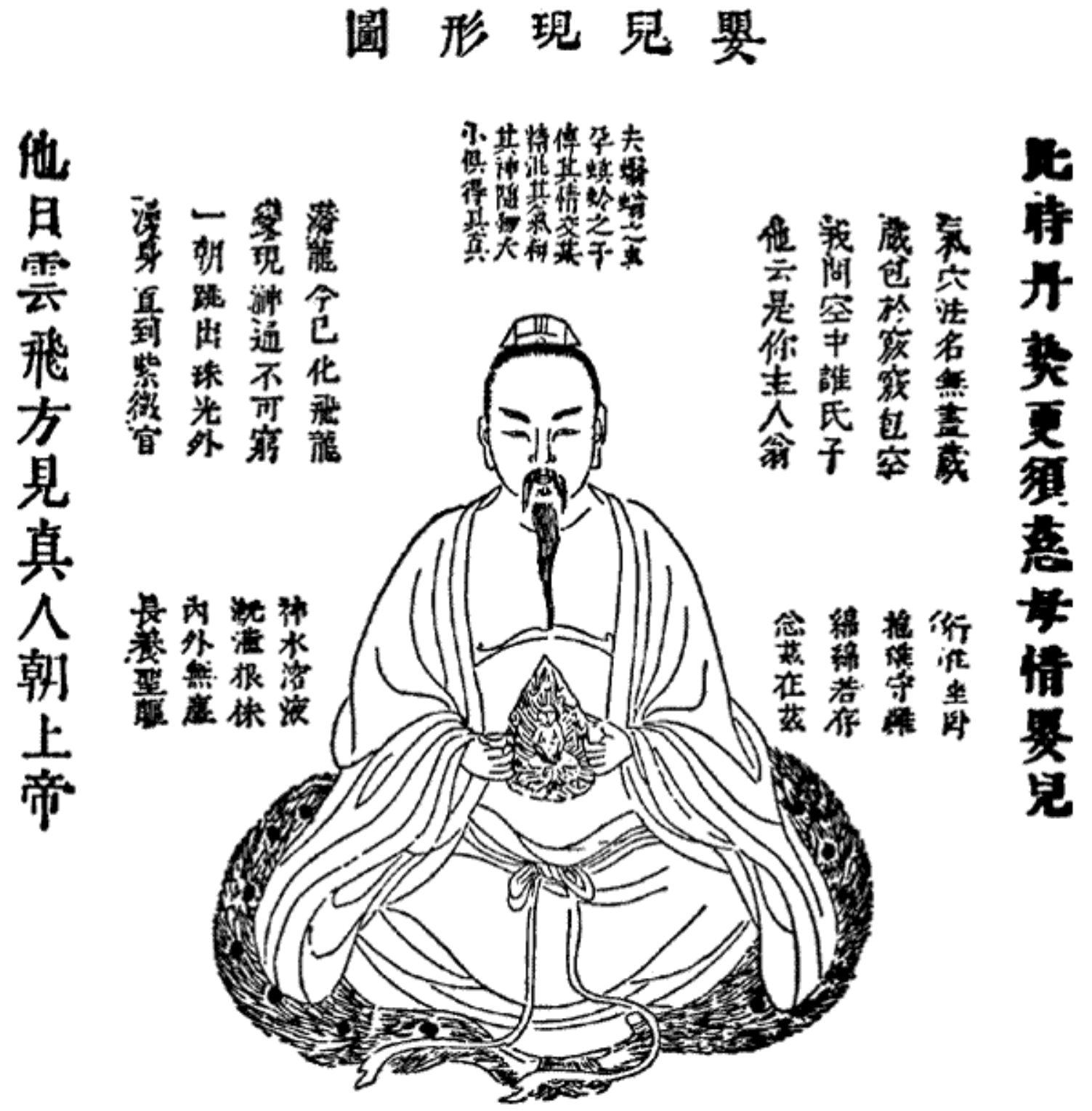
Over the past several years, I have received many questions from students and clients regarding internal cultivation. Some of them have followed different teachers, purchased expensive courses, or practiced countless forms of “meditation,” only to feel confused, directionless, and unsure whether anything meaningful was happening.
Many told me the same thing:
“It feels like I’m just sitting there. Everyone says this is internal alchemy, but nothing actually changes.”
“Some methods look impressive on the surface, but when we practice them, it feels hollow.”
“I want to learn the real Daoist method, not the commercialized versions online.”
Their experiences are not unusual.
Today, the internet is full of thousands of “inner alchemy methods,” ranging from imagination-based microcosmic orbits, to breath-manipulation, to chakra-style visualizations borrowed from unrelated systems. Some are well-intended but misguided; some are dangerous; most have little relation to classical Daoist cultivation.
In contrast, true Daoist inner alchemy emphasizes naturalness, stability, subtle observation, and the gradual return of spirit and breath to their original source.
Among all the classical texts, one stands out for being both profound and accessible:
The Secret of the Golden Flower
This blog series will share how I read and understand this text, from the perspective of a Feng Shui Master and a Quan Zhen Daoist Magic Master, and how the classical instructions can be applied safely and clearly in modern daily life.
This first post focuses on Chapter One: The Heavenly Mind.
What Chapter One Is Really Saying
Although the chapter appears poetic on the surface, it actually reveals the entire foundation of the method.
If you read carefully, Chapter One teaches:
- The location of the practice
- The substance of the cultivation
- The direction of the method
- The central action
- The expected effect
- The first milestone of success
In short, Chapter One contains the blueprint of the entire system. The remaining chapters simply add clarification.
The Heavenly Mind: The Inner Center of the Practice
The central instruction of this chapter is simple:
Return the light to the Heavenly Mind.
The Heavenly Mind is not symbolic. It is an actual inner point, located within the space behind the point between the eyebrows. It is not on the surface of the forehead but within the skull, two to three centimeters inward, in a quiet, empty space.
Daoist texts call it:
The Mysterious Pass
The Yellow Court
The Spirit Terrace
The Square Inch Palace
These are not poetic names. They describe the same center where the original spirit resides and where the light of awareness naturally gathers when it is no longer scattered outward.

When the attention rests here, several things begin to happen naturally:
Breath becomes finer
Thoughts gradually settle
Scattered energy returns inward
A subtle brightness emerges
Awareness becomes unified and centered
This is the true starting point of the Golden Flower practice.
What “Turning the Light Around” Means
One of the most misunderstood instructions in the entire book is the phrase “turning the light around.”
Modern readers often assume it means:
Focusing intensely on the forehead
Imagining light
Visualizing a ball of energy
Breath manipulation
Forcing the mind to be still
None of these are the method.
“Turning the light around” simply means:
The outward flow of attention, which normally rushes toward the world, reverses itself.
Instead of being pulled outward by stimuli, emotions, screens, conversations, and endless thoughts, it settles inward at its source.
This shift is extremely subtle.
It is not something you “do with force”; it is something you allow by ceasing to chase external impressions.
Chapter One emphasizes that the entire method is based on reversal.
Ordinary attention leaks outward;
the practice teaches how to let it return.
When Light Gathers, the Golden Flower Appears
When the awareness repeatedly returns to the Heavenly Mind:
The light begins to gather.
When the light gathers, it condenses.
When it condenses, it becomes luminous.
This luminous condensation is what the text calls the Golden Flower.
It is not a metaphor.
It is a direct inner experience of clarity, presence, and brightness in the center of the head.
When this begins to stabilize, inner stillness deepens, and the spiritual body begins to form.
This is the meaning of the line:
“When the light crystallizes, the spiritual body is born.”
This is the true beginning of internal alchemy.
A Simple and Safe Practical Method
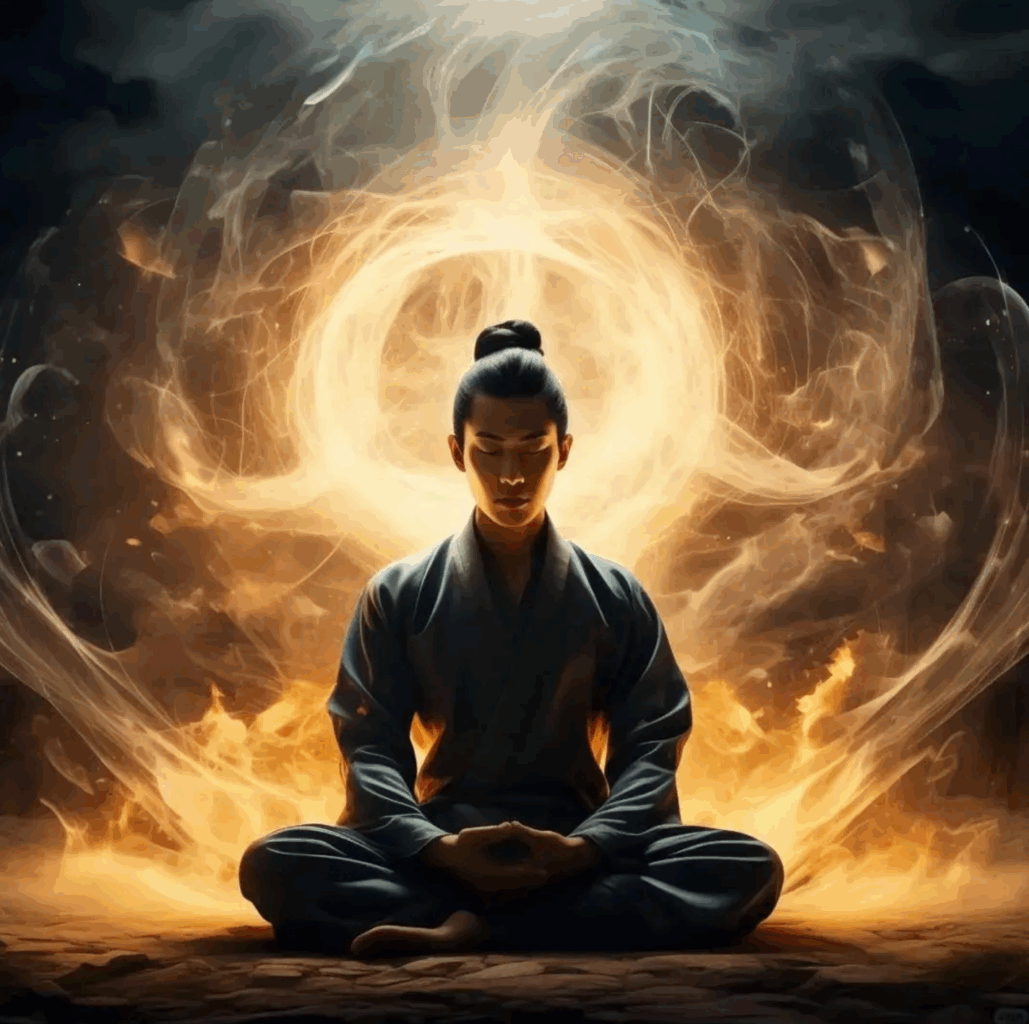
For beginners or anyone reading this text for the first time, here is a safe and straightforward way to begin:
Step 1: Sit naturally.
Allow your body to settle. Do not tighten your abdomen or try to breathe in a specific rhythm.
Step 2: Lower the eyelids halfway.
This is the classical instruction “to let the eyelids hang like curtains.”
You should be able to faintly see the tip of your nose.
Step 3: Allow your awareness to rest in the space behind the eyebrows.
Do not stare.
Do not focus.
Do not try to see anything.
Simply let your attention relax into that inner point.
Step 4: Let the breath follow naturally.
Do not intervene in the breathing.
Naturalness is the key.
Step 5: Recognize the signs of inwardness.
If you are practicing correctly, you may notice:
a gentle brightness,
a settled feeling in the mind,
a sense of inward depth,
the breath becoming subtle without effort,
or a quiet presence in the center of the head.
These early signs are the beginning of “light returning.”
This is all you need for now.
Do not rush toward visualizations, energy manipulation, or orbit techniques.
Chapter One itself is enough to practice for quite a while.
Why I Personally Appreciate This Chapter
As a Feng Shui practitioner, I often compare the process of “turning the light around” to the process of balancing the qi of a home.
A house with scattered qi cannot store prosperity.
A person with scattered attention cannot store light.
When students or clients say they feel confused after years of meditation, the issue is almost always the same: the methods they learned focus on silence or relaxation, but not on collecting and refining the inward light.
Chapter One teaches the missing key:
how to gather spirit, stabilize awareness, and return to the true center.
This is why I believe The Secret of the Golden Flower is one of the most direct and elegant manuals of internal cultivation.
Closing Thoughts
This post is part of a series exploring each chapter of The Secret of the Golden Flower.
I will continue sharing my personal understanding, practitioner insights, and explanations of how these classical instructions fit into the broader Daoist cultivation system.
If readers show interest, I may also organize my private notes into a small study guide so others can follow the method more easily.
In the next post, we will explore Chapter Two, which explains the difference between the Original Spirit and the Conscious Spirit—one of the most important distinctions in Daoist cultivation.
Feng Shui Master
Quan Zhen Lineage Daoism Magic Master
40th Gen Holder of the Esteemed Yang Gong Lineage
Xuan Kong Liu Fa · Xuan Kong Da Gua · Classical Form School
Join my Facebook Group: Willow’s Feng Shui Best Guide
My Instagram: fengshuidigest
My Website: https://fengshuidigest.com/
My Talismans: Authentic Customized Talismans